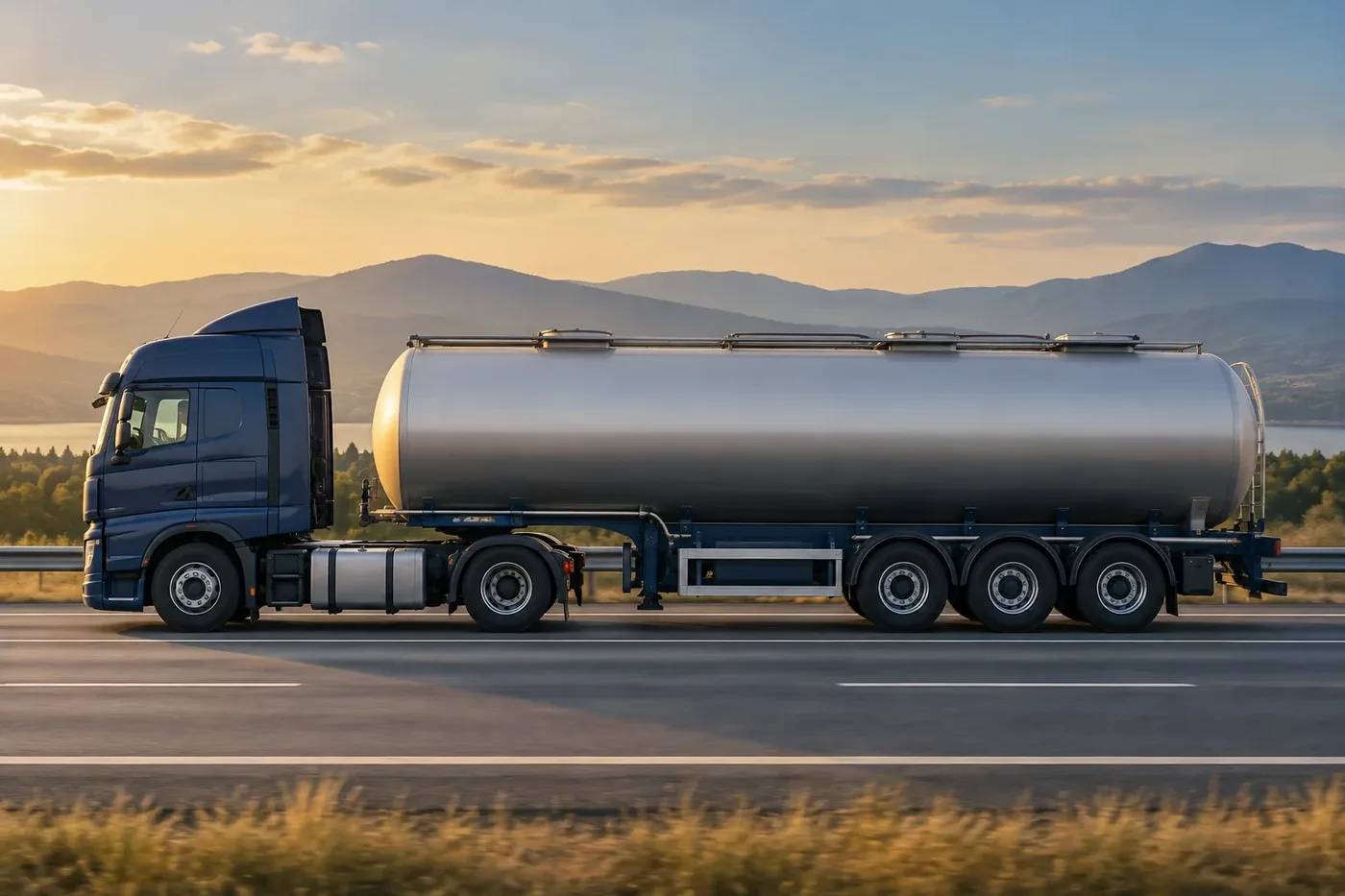
Tanker CDL Practice Test
The Tanker (N) endorsement is required to drive any commercial vehicle that hauls liquid or gaseous bulk loads in tanks of certain sizes. The handling characteristics of a partially filled tank — surge, side-to-side roll, fore-and-aft slosh — make tanker driving distinctly different from box-trailer driving.
What's on the Tanker exam
Most states administer 20 Tanker questions and require 80% to pass. Topics include the unique handling of liquid loads, surge effects, baffles vs. smooth-bore, outage and expansion, inspection of the cargo tank, and emergency procedures.
Topics covered
- Tank vehicle definition and CDL implications
- Inspecting tank vehicles: special items
- Driving tank vehicles: high center of gravity
- Surge: front-to-back and side-to-side
- Smooth bore vs. baffled tanks
- Outage and load thermal expansion
- Stopping distance with liquid loads
- Emergency response for tanker incidents
Who needs this endorsement
Drivers hauling liquid or gaseous bulk in a tank with a rated capacity of 1,000 gallons or more, on a vehicle with a tank-type cargo body. Combined with the H endorsement (often written X), it is required to haul liquid hazmat such as fuel.
All 50 Tanker Practice Questions
Click any answer to reveal the correct one and the explanation. Take a state-specific 20-question round, in randomized order, on any of the state pages.
A "tank vehicle" requiring an N endorsement is generally defined as:
Correct. The N endorsement is required for any commercial vehicle hauling liquid or gas in a permanently mounted tank or portable tank with rated capacity of 1,000+ gallons (and individual tanks of 119+ gallons).
Liquid in a partially filled tank causes:
Correct. Surge is the side-to-side or front-to-back movement of liquid in a partially filled tank — it can throw the rig forward, pull it sideways, and significantly affect handling.
A "smooth bore" tank has:
Correct. A smooth-bore tank has no internal divisions or baffles. Surge is dramatic; brake gently to avoid being pushed forward by the load.
A "baffled" tank has:
Correct. Baffled tanks have internal bulkheads with holes — they slow surge but still allow product to flow through during loading and unloading.
Compartmented tanks have:
Correct. Compartmented tanks have liquid-tight bulkheads. Each compartment is loaded separately, allowing different products in one trailer.
Side-to-side surge is most likely to cause:
Correct. Side-to-side surge can amplify side-loading forces, contributing to rollover on curves and exit ramps.
Front-to-back surge is most likely to cause:
Correct. Front-to-back surge pushes the rig forward when you brake — drivers have been pushed through stop lines by an unexpected forward surge.
Tankers have a high center of gravity because:
Correct. A tank carries its load high above the road. The center of gravity is much higher than for a flatbed of the same weight, increasing rollover risk.
Outage refers to:
Correct. Outage is the empty space left at the top of a tank to allow liquid to expand as it warms. Different liquids require different outage percentages.
You should never load a tank completely full because:
Correct. Liquids expand with temperature. Without outage, a warming load can over-pressurize and rupture the tank.
When driving a tanker, you should:
Correct. Posted advisory speeds assume cars. A loaded tanker may roll over at the posted speed — slow well below posted speeds for ramps and curves.
When braking a partially filled smooth-bore tank, you should:
Correct. In smooth-bore tanks, surge is severe. Brake gently and earlier than you would in a dry-van trailer to avoid being pushed forward.
When the surge in a tanker pushes the rig forward at a stop, you may:
Correct. Forward surge can push the entire rig forward — past stop lines, into intersections, into the vehicle ahead. Plan your stops with extra distance.
Tanker pre-trip should specifically check:
Correct. In addition to standard pre-trip, inspect the tank shell, all valves, manhole covers, vents, and pressure-relief devices.
Tankers should be driven with:
Correct. Tankers stop slower and roll easier. Increase following distance and use gentler steering and braking inputs.
When loading a cargo tank with flammable liquid, the driver must:
Correct. Federal rule: driver remains within 25 feet, alert, with a clear view, ready to act in case of overflow or emergency.
Bonding and grounding during product transfer:
Correct. Static electricity builds up during liquid transfer. Bonding (cable between tank and receiving container) plus grounding equalizes potential to prevent ignition.
Empty tankers handle:
Correct. Empty tankers have less brake traction (less weight on tires) and are more affected by crosswinds. Never assume empty equals safer.
A tanker with a high center of gravity is most prone to rollover during:
Correct. High center of gravity makes tankers roll on tight curves, sudden lane changes, and exit ramps. Slow well in advance.
When you drive a tanker on slippery roads, you should:
Correct. Reduce speed by at least one-third on wet roads, by half on snow. Liquid loads make recovery from a skid much harder.
When you discover a leak in a cargo tank carrying flammable liquid:
Correct. A leaking flammable cargo tank is a major incident — secure the area, evacuate per the ERG, contact emergency services. Never attempt roadside cargo transfer.
A loaded tanker on a curve is most likely to:
Correct. Side surge plus high CG creates a tipping moment well above what a flat-bed of equal weight produces. Speed reduction in advance is the only safe answer.
Pressure relief devices on cargo tanks are designed to:
Correct. Pressure relief valves open at a set pressure to prevent tank rupture. Tampering with them is illegal and dangerous.
Cargo tanks must be inspected and tested:
Correct. Cargo tanks have specific inspection and test schedules based on their DOT specification (visual, leakage, internal, pressure, and thickness tests).
When unloading product from a cargo tank, you should:
Correct. Pre-check receiving container, bond and ground, control flow rate to prevent splash and spill, and remain attentive for flammable liquids.
A tanker hauling food-grade product (e.g., milk):
Correct. Smooth-bore tanks (no internal baffles) are easier to clean for food-grade products. The trade-off is severe surge — drive slower and brake earlier.
A "bottom-loaded" tank:
Correct. Bottom-loading uses sealed bottom-loading equipment with vapor recovery, reducing static and vapor escape compared to splash-loading from the top.
When driving with a load that has a low specific gravity (e.g., gasoline) versus high (e.g., asphalt), you should:
Correct. Different products have different densities, surge characteristics, and weight distributions. Adjust speed and braking for the load.
Vapor recovery during loading:
Correct. Vapor recovery captures flammable vapors displaced as product is loaded, returning them to storage. Required at most modern fuel terminals.
A double trailer tanker requires:
Correct. Pulling more than one tank requires Doubles/Triples (T) plus Tanker (N) endorsements. Add Hazmat (H) — together written X — for hazardous liquid loads.
When you stop a placarded tanker carrying flammable liquid at a railroad crossing, you must stop:
Correct. Placarded hazmat (which most fuel tankers are) must stop 15 to 50 feet from the nearest rail. Look, listen, and cross only when clear.
A heavy liquid load with a baffled tank may still surge:
Correct. Baffles reduce front-to-back surge but do not affect side-to-side surge — bulkheads are typically transverse, not longitudinal.
When backing a tanker, you should:
Correct. Tankers can have unusual mirror angles and rear visibility. Use a helper, move slowly, and watch for tank-mount lights and overhead clearance.
When carrying water (a non-hazmat liquid) in a tanker, you still need:
Correct. The N endorsement is based on the vehicle being a tank, not on the cargo. Even non-hazardous water requires the N endorsement if the tank meets size criteria.
When emergency-braking a smooth-bore tanker:
Correct. Forward surge can dramatically push a smooth-bore tank rig further than expected. Plan stopping distance with significant additional margin.
On a wet road, a tanker should:
Correct. On wet pavement, reduce speed by about one-third. On snow, by about one-half. Tankers are less forgiving than dry vans on slippery roads.
Outage requirements:
Correct. Outage requirements differ by product. Gasoline expands more than diesel, ethanol expands differently, etc. Check the shipping paper or product specifications.
A pressure-relief device that vents during transit:
Correct. Continuous venting indicates over-pressure (often from over-fill or sun heating an over-filled tank). Stop and investigate; do not continue with a venting tank.
Loading dock procedure for cargo tanks of flammable liquid:
Correct. Standard loading-rack procedure: brake set, chocks in, engine off, bond and ground, monitor loading, follow rack-specific procedures (vapor recovery, load arms, etc.).
A tank with multiple compartments may have:
Correct. Compartmented tanks (common on fuel-delivery trucks) carry different grades or different products. Verify the destination tank before opening any discharge valve.
Carrying a smooth-bore tank up a ramp or off a curb:
Correct. Climbing causes the load to surge backward and then forward as you level off — affecting throttle response, traction, and braking.
Tank specification "MC-306" or "DOT-406" generally refers to:
Correct. MC-306 (older) and DOT-406 (current) are non-pressure cargo tanks for flammable and combustible liquids — typical fuel tankers.
Tank specification "MC-307" or "DOT-407" generally refers to:
Correct. MC-307/DOT-407 are insulated low-pressure tanks for chemicals — common for many industrial liquids.
The driver should plan extra time for:
Correct. A loaded tanker accelerates slower, brakes longer, and turns wider. Plan your trip and reactions accordingly.
When driving a tanker through a sharp bend at the recommended speed for cars:
Correct. Tanker rollovers regularly happen at posted "car" curve speeds. Slow well below posted speeds in a loaded tanker.
In the event of a fire on a tanker:
Correct. Pull to a safe area, away from buildings and people. Get out, call 911, and consult the ERG. Some tank fires (e.g., water on flammable liquid) make matters worse.
A tanker with an empty compartment between two full compartments may:
Correct. Mixed full and empty compartments produce complex surge patterns. Plan acceleration and braking conservatively.
Tank vehicles should not be driven:
Correct. On long downgrades, select a low gear before starting down and use firm intermittent brake applications to prevent fade.
When unloading from a top-mounted hatch, you should:
Correct. Top-mount work involves fall hazard. Use the ladder safely, follow fall-protection procedures, and secure hatches after.
A loaded tanker traveling 10 mph above the safe curve speed has a:
Correct. Centripetal force scales with speed squared. Just 10 mph over safe speed can take you past the rollover threshold of a loaded tanker.