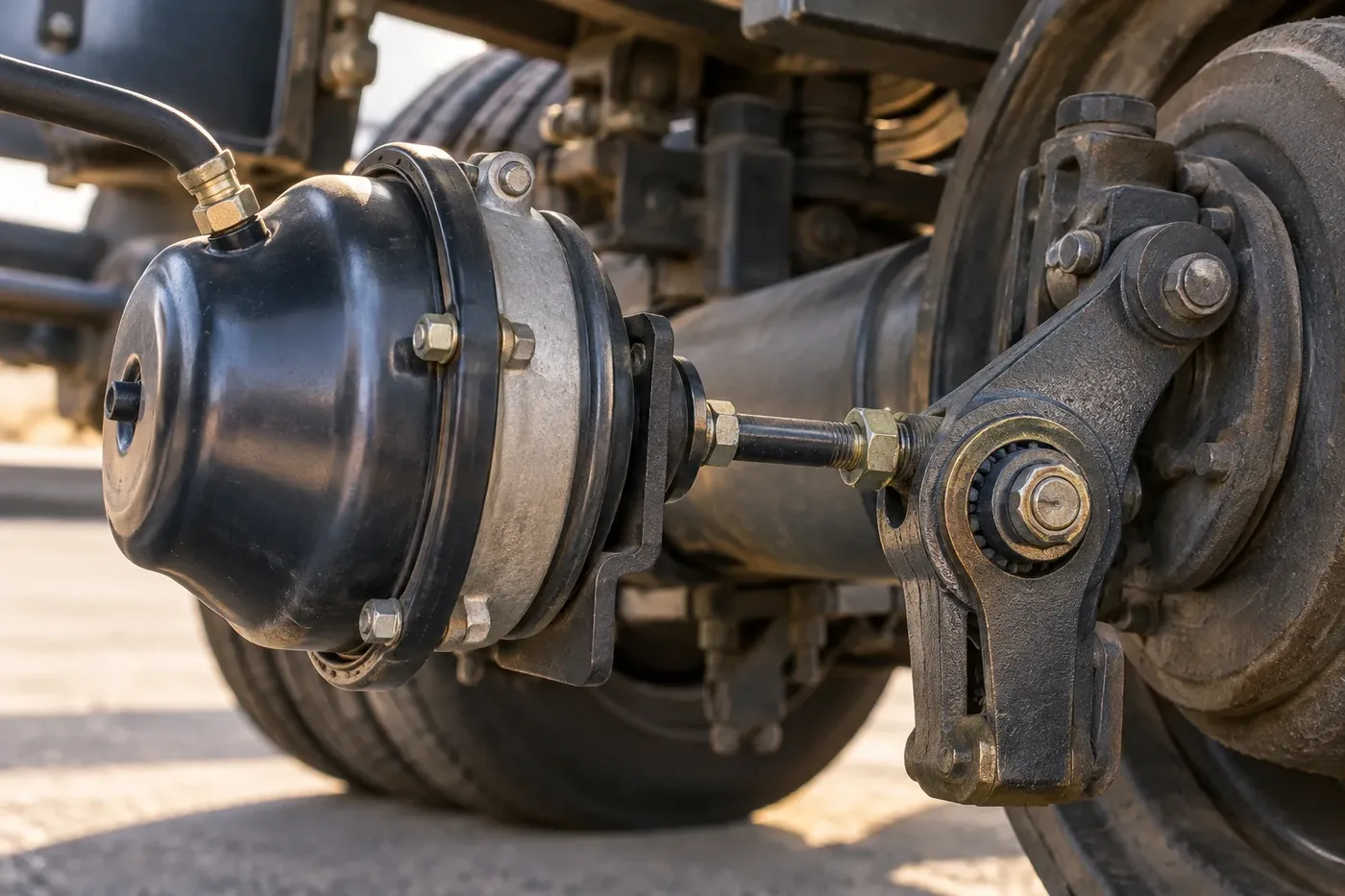
Air Brakes CDL Practice Test
The Air Brakes test covers the dual air-brake system used on virtually every modern commercial vehicle. If you skip this test or fail it, your CDL will carry an "L" restriction that prevents you from operating any vehicle with air brakes — which rules out almost every truck on the road. The air-brakes exam is the most-failed CDL knowledge test, so plan extra study time.
What's on the Air Brakes exam
States typically administer 25 Air Brakes questions and require 80% to pass. Questions cover air-brake system parts, dual systems, supply pressure, brake-system warning, slack adjusters, the parking brake, the spring brake, the pre-trip air-system check, and the proper way to perform a leakage-rate test.
Topics covered
- Air-brake system parts and how they work
- Dual air-brake systems
- Supply pressure, governor cut-in and cut-out
- Air pressure gauges and warning devices
- Slack adjusters: manual and automatic
- S-cam, wedge, and disc brakes
- Spring brakes and parking brake control
- Front-wheel brake limiting valve
- Brake fade and proper downhill braking
- Pre-trip air-system inspection (seven-step)
- Leakage rate calculation
- Stab braking and controlled braking
- Antilock braking systems (ABS)
Who needs this endorsement
Anyone who plans to drive a vehicle equipped with air brakes — which is essentially every commercial truck and bus over 26,001 lbs GVWR. The skills test must be taken in a vehicle with full air brakes to remove the air-brake restriction.
All 71 Air Brakes Practice Questions
Click any answer to reveal the correct one and the explanation. Take a state-specific 20-question round, in randomized order, on any of the state pages.
The parts of an air-brake system include:
Correct. Air-brake systems use a compressor, governor, storage tanks, foot valve, and brake chambers — distinct from hydraulic systems used in cars.
The governor controls:
Correct. The governor cycles the compressor: it cuts the compressor in around 100 psi and cuts it out around 125 psi.
Air storage tanks are used to:
Correct. Air storage (or "supply") tanks hold compressed air ready for brake application. Trucks have multiple tanks for redundancy.
Air tanks must be drained because:
Correct. Water and compressor oil collect at the bottom of air tanks. They must be drained to keep the system clean and prevent winter freeze-ups.
The S-cam:
Correct. When the foot valve is pressed, air pushes the brake-chamber pushrod, which moves the slack adjuster, which rotates the S-cam shaft, forcing the shoes against the drum.
Slack adjusters need to be checked because:
Correct. Slack adjusters control how far the pushrod must travel to apply the brake. Out-of-adjustment slack adjusters are the leading mechanical cause of out-of-service violations.
Manual slack adjusters must be adjusted:
Correct. Drivers may adjust manual slack adjusters in compliance with manufacturer specifications. Automatic slack adjusters are now standard but still require periodic checking.
The supply pressure gauges show:
Correct. The supply (primary and secondary) pressure gauges show air pressure available for braking — a critical reading before driving and during operation.
The application pressure gauge shows:
Correct. The application gauge (when present) shows brake-application pressure — useful for spotting brake-system problems on long downgrades.
A low-air-pressure warning device must come on at or before:
Correct. A federal-mandated low-air-pressure warning (light, buzzer, or wig-wag) must activate at or before 60 psi.
In a dual air-brake system, the time required for air pressure to build from 85 to 100 psi should be no more than:
Correct. In dual air-brake systems, air should build from 85 to 100 psi within 45 seconds at engine governed RPM.
The spring brakes:
Correct. Spring brakes use heavy springs that apply the brake when air pressure is released or drops below 20-45 psi — they serve as both parking and emergency brake.
The parking-brake control:
Correct. The parking-brake control is a yellow diamond-shaped knob, distinct from the red round trailer-supply knob.
The trailer air-supply control:
Correct. The trailer air-supply (tractor protection) is a red eight-sided knob. Push in to supply air to the trailer; pull out to shut off air.
When should you NOT use the parking brakes?
Correct. Hot brakes can be damaged by the spring brakes contracting against hot drums. Let the brakes cool before parking.
When should you use the trailer hand valve to slow the rig?
Correct. Using the trailer hand valve alone applies brakes only at the trailer wheels and can cause the trailer to lock up and skid. Always use the foot valve to brake.
Pre-trip air-brake check (Step 1) is to:
Correct. In the seven-step air-brake check the first step is testing the parking brake — release service brakes, set parking brake, gently try to move the vehicle in low gear.
For a single vehicle (not a combination) with engine off and brakes released, the maximum allowable air-loss rate is:
Correct. A single vehicle is allowed no more than 2 psi/min of air loss with engine off and brakes released.
For a combination vehicle (tractor and trailer) with engine off and brakes released, the maximum allowable air-loss rate is:
Correct. A combination vehicle is allowed no more than 3 psi/min with brakes released, or 4 psi/min with brakes applied.
For a single vehicle with engine off and brakes applied, the maximum allowable air-loss rate is:
Correct. A single vehicle is allowed no more than 3 psi/min with brakes fully applied.
In a dual air-brake system, you should let the air pressure build to at least what level before driving?
Correct. Wait until the system pressure is at least 100 psi before driving in a dual air-brake system.
You hear a steady "ssss" sound while parked with the engine off. This is most likely:
Correct. A steady hiss with the engine off indicates an air leak — find and repair before driving.
When you make a normal stop with air brakes, you should:
Correct. For normal stops, apply steady firm pressure on the foot valve and adjust to maintain a smooth stop.
A long downgrade requires:
Correct. Pick a low gear before starting down. Use the brakes in firm, intermittent applications: brake to 5 mph below safe speed, release, repeat.
Continuous use of the brakes on a long downgrade can cause:
Correct. Holding the brakes overheats them and causes brake fade — drums expand and brake compounds lose effectiveness, reducing braking force.
Brake fade is the result of:
Correct. Brake fade comes from heat. Manage downgrade speed by gear selection plus intermittent firm brake use, not continuous light pressure.
You should perform a static air-leakage test by:
Correct. Engine off, brakes released, fully charged system: watch for air loss over one minute. Then apply brakes and check again.
When the spring brakes apply automatically as air pressure drops, this typically happens between:
Correct. Spring brakes will fully apply somewhere between 20 and 45 psi as system pressure drops, depending on the vehicle.
In an emergency stop on a non-ABS vehicle, you should:
Correct. Stab braking applies brakes hard until the wheels lock, then releases when you feel skid — this slows the vehicle while keeping it straight.
On a vehicle with ABS, in an emergency stop you should:
Correct. ABS lets you brake hard and continue steering. Brake firmly and avoid pumping — pumping defeats the system.
Air brakes take longer to work than hydraulic brakes because:
Correct. Brake-lag in air systems comes from the time air takes to travel through lines and reach all the brake chambers — typically 0.4 seconds added to perception/reaction time.
Stopping distance for a vehicle with air brakes is the sum of:
Correct. Air-brake stopping distance is perception + reaction + brake lag + braking — the brake lag is the unique addition.
When brake drums or shoes get very hot, you should:
Correct. Park where you can let the brakes cool. Do not apply the parking (spring) brake on overheated brakes — it can damage them or cause warpage.
Wet brakes:
Correct. After fording water, brakes may be wet. Drive slowly while applying light brake pressure to dry them.
A condition called "brake fade" is most likely on:
Correct. Brake fade comes from heat from extended use — most commonly on long, steep downgrades where the brakes are working continuously.
Which of these is the safest speed for descending a long, steep grade?
Correct. Choose a speed and gear that lets the brakes work intermittently without continuous pressure. Posted truck-grade signs help.
The "brake-system warning device" must come on no later than:
Correct. A federal-rule low-air-pressure warning device must activate at or before 60 psi.
Modulating valves on the trailer:
Correct. The trailer service brakes are modulated — pressing harder on the foot valve produces more brake-chamber pressure at the trailer.
After connecting the trailer air lines, you should:
Correct. Charge the trailer system, then test the trailer brakes by pulling out the trailer-supply knob to make sure they hold the trailer.
The "tractor protection valve" closes (cuts off air to the trailer) automatically when:
Correct. The tractor protection valve protects the tractor from a runaway air loss in case of a trailer break-away or air leak — it closes between 20 and 45 psi.
If a trailer breaks away, the emergency brakes on the trailer will be applied because:
Correct. When the air line breaks (or is disconnected), trailer air pressure drops and the trailer spring brakes apply, stopping the trailer.
You should never leave the vehicle unattended without:
Correct. Set the parking brake. On grades or where unintended movement could occur, chock the wheels in addition.
Air brakes are actually three brake systems combined:
Correct. A complete air-brake system has the service brake (foot valve), parking brake (spring/yellow knob), and emergency brake (which is the parking brake working off the spring brake when air drops).
Pushing the brake pedal harder makes:
Correct. The foot valve modulates air pressure to the brake chambers in proportion to how hard you press the pedal.
If you must drive a vehicle with manual front-wheel-brake limiting valve, you should keep it in the "normal" position:
Correct. Keep the front-wheel limiting valve in the "normal" position. Modern trucks rarely have this valve, but if equipped, leaving it in "slippery" reduces front braking and lengthens stopping distance.
Antilock braking systems (ABS):
Correct. ABS prevents wheel lockup during hard braking, allowing you to steer to safety. ABS does not necessarily shorten stopping distance.
A yellow ABS malfunction lamp on the cab dash means:
Correct. A yellow ABS lamp on the dash indicates a tractor-ABS malfunction. The base brakes still work normally, but ABS is unavailable until repaired.
A yellow ABS malfunction lamp on the trailer (typically left side) means:
Correct. A trailer-mounted yellow ABS lamp indicates the trailer's ABS is malfunctioning. Service brakes still work; have the system repaired.
You should test the parking brake by:
Correct. After applying the parking brake and releasing the service brakes, gently try to move forward in low gear. If the vehicle moves, the parking brake is not holding.
The service brakes are operated by:
Correct. Service brakes are applied by the foot valve / brake pedal. The yellow and red knobs control parking and trailer-supply functions.
Air-brake disc brakes use:
Correct. Disc brakes use a brake chamber and slack adjuster like S-cam drum brakes, but the force closes a caliper on a rotor instead of forcing shoes against a drum.
When checking the brakes on a downgrade, you should:
Correct. Watch the air-pressure gauge. If pressure drops faster than the compressor can recover, brakes are being used too aggressively for the gear selection.
A "wet tank" is:
Correct. The first storage tank — sometimes called the wet tank or supply tank — is where water and oil from the compressor collect. Drain it daily.
You should drain the air tanks:
Correct. Drain all air tanks at the end of each working day to remove water and compressor oil that has condensed in the tanks.
Brake drums or discs that have cracks larger than ___ the width of the friction area should be replaced:
Correct. Cracks longer than one-half the width of the friction area indicate the drum is unsafe and must be replaced.
Total stopping distance with air brakes equals:
Correct. Add brake-lag distance to the standard perception + reaction + braking distance for any vehicle with air brakes.
In a fully charged dual air-brake system at idle, you should test the low-pressure warning by:
Correct. Engine off, fan the brake pedal to bleed pressure. The low-pressure warning device should activate before pressure drops below 60 psi.
When the air-pressure protection valve closes during driving (because pressure dropped too low), the trailer:
Correct. When tractor air pressure falls into the 20-45 psi range, the protection valve closes, cutting trailer air, which causes the trailer spring brakes to apply.
You are driving a fully loaded combination vehicle on a steep downgrade. Your safe speed is 30 mph and you have already shifted to a lower gear. The proper braking technique is to:
Correct. The "snub-and-release" method: brake firmly to drop 5 mph below safe speed, release until safe speed returns, repeat. Holding the brakes overheats them.
When releasing brakes after a hard stop, you should:
Correct. Release the brakes smoothly. Air tanks refill while you drive; allow the compressor to recharge the system before the next braking event.
The air compressor is driven by:
Correct. The air compressor is engine-driven, typically through gears at the front of the engine or by a v-belt.
Modern trucks have ABS that is required on:
Correct. Federal rule: tractors built after March 1, 1997, and trailers and single-unit air-braked vehicles after March 1, 1998, must have ABS.
You are driving a tractor-trailer with the air-pressure gauge dropping rapidly. You should:
Correct. A rapid drop in air pressure indicates a serious leak. Pull over before the pressure drops to the point where the spring brakes apply and the vehicle stops on the road.
The brake-system warning light or buzzer is designed to alert you when:
Correct. The brake-system warning device alerts you to dangerous low air pressure — typically activating at or before 60 psi.
During a brake check, the brake pedal should not move more than ___ when you push it down hard with the engine off and air pressure built up:
Correct. After full charge, holding the foot valve down should produce a firm pedal that moves only a few inches. Pedal sinking to the floor indicates a leak.
Modern dual-circuit air-brake systems are required so that:
Correct. Dual systems separate primary and secondary brake circuits so that a failure in one (rear or trailer) still leaves brakes available on the other axle group.
To check air-brake adjustment quickly, you can:
Correct. Pushrod travel beyond about 1 inch (varies by chamber size) indicates an adjustment issue. Use a marked stroke check or have a mechanic verify.
Air-brake adjustment is critical because out-of-adjustment brakes:
Correct. Out-of-adjustment slack adjusters reduce braking force at the wheel, increasing stopping distance and risking brake failure on long downgrades.
Air loss from the brake system on a moving combination vehicle, with brakes applied, should not exceed:
Correct. Combination vehicle, brakes applied, engine off: no more than 4 psi/min air loss. Engine off, brakes released: no more than 3 psi/min.
You should never use the parking brake when the brakes are very hot because:
Correct. Hot brakes cooled with parking brake applied can warp the drum or rotor, or cause the spring brake to fail to release.
You should check the air-system pressure build-up time during pre-trip:
Correct. In dual air-brake systems, the air should build from 85 to 100 psi within 45 seconds with the engine at governed RPM.