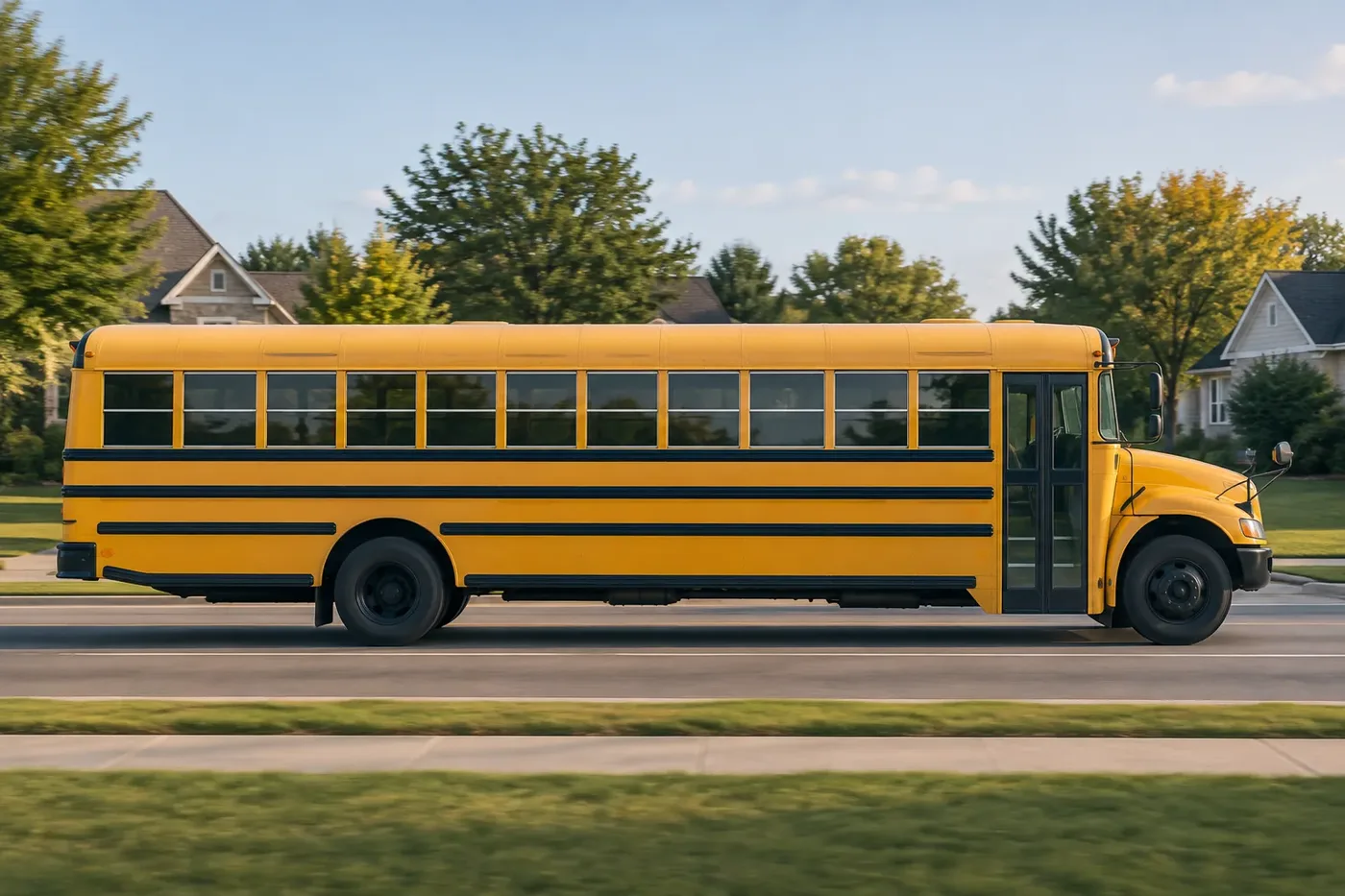
School Bus CDL Practice Test
The School Bus (S) endorsement is required, in addition to the Passenger (P) endorsement, to operate a school bus that transports students between home and school or to school-related activities. The S endorsement requires both a knowledge test and a skills test in a school bus.
What's on the School Bus exam
Most states administer 20 School Bus questions and require 80% to pass. The exam emphasizes loading and unloading procedures, the danger zone around the bus, emergency exit and evacuation procedures, railroad-highway crossings, and student management.
Topics covered
- Pre-trip inspection of a school bus
- The danger zone and mirror use
- Loading and unloading at the bus stop
- Crossing students at the stop
- Activated lights and stop arm
- Railroad crossings: full stop, open door
- Backing in the school bus
- Behavior management and discipline
- Emergency evacuation procedures
- Securing the bus when leaving
- Anti-bullying and Special Needs students
Who needs this endorsement
Anyone driving a school bus to transport students. The endorsement requires a federal background check (varies by state), a clean driving record, and successful completion of an initial S-endorsement training course.
All 55 School Bus Practice Questions
Click any answer to reveal the correct one and the explanation. Take a state-specific 20-question round, in randomized order, on any of the state pages.
The "danger zone" around a school bus is generally:
Correct. The danger zone extends 10 feet in front, 10 feet on each side, and 10 feet behind the bus, plus the area needed to maneuver. Most students killed by their own bus are in this zone.
Most school-bus fatalities of students happen:
Correct. The majority of student deaths involving school buses occur outside the bus, often in the danger zone right after unloading.
When approaching the bus stop, you should activate the alternating amber warning lights:
Correct. Activate amber warning lights about 200 feet before the stop (further in higher-speed zones), giving traffic time to slow.
When stopped to load or unload students, the bus driver should:
Correct. Standard procedure: parking brake set, neutral, red flashers and stop arm out, count students on/off, mirror check before resuming.
The minimum distance the front bumper of a stopped school bus should be from waiting students at the stop:
Correct. Stop with the front bumper at least 10 feet from waiting students so they have to walk forward to enter the bus, ensuring the driver can see them.
When students must cross the road to reach or leave the bus, they should:
Correct. Crossing students walk at least 10 feet ahead of the bus, in clear view, after the driver signals it is safe.
Before resuming travel after a stop, the driver should:
Correct. Mirror sweep, count crossing students, verify clear danger zone, deactivate lights and stop arm, proceed slowly.
A school bus must stop at every railroad crossing:
Correct. School buses must stop at every railroad crossing 15 to 50 feet from the nearest rail. Open the entrance door and driver window, look and listen, then proceed without shifting gears.
When stopped at a railroad crossing in a school bus, the driver should:
Correct. Open door and window, eliminate noise from the bus, look both ways, listen for whistles and bells. Cross only when clear.
When backing a school bus, you should:
Correct. Backing in a school bus is the highest-risk maneuver. Avoid it. If required, use a helper, sound the horn, do not back across roadways, and ideally do not back with students aboard.
A school bus evacuation is required when:
Correct. Evacuate for fire, danger of fire, on/near railroad tracks, in path of a train, or danger of being hit by another vehicle.
When evacuating students, they should be moved to a safe area:
Correct. Move students at least 100 feet away, off the roadway, in the direction of oncoming traffic so they can see and be seen by approaching drivers.
Pre-trip inspection of a school bus should include:
Correct. Standard CMV inspection plus school-bus-specific equipment: lights, stop arm, crossing arm, lift, kits, mirror condition.
A school bus must have how many mirrors at minimum?
Correct. School buses have side mirrors plus crossover mirrors at the front so the driver can see the danger zone in front of the bus and on the right.
After unloading at the end of the route, the driver must:
Correct. Always walk every aisle and check every seat. Sleeping children left aboard a parked bus is a recurring tragedy that the post-trip walk prevents.
When a bus is in motion, students must:
Correct. Seated, facing forward, hands and feet to themselves, aisle clear. This protects them in any sudden stop.
You see a student running back toward the bus after being unloaded. You should:
Correct. Stop and account for the student. Many fatal incidents involve students returning for forgotten items in the danger zone.
The school bus stop arm:
Correct. The stop arm signals approaching traffic to stop. Drivers who pass a stopped school bus with red lights flashing face heavy fines.
When loading students at the stop, the driver should:
Correct. Count students before, during, and after loading. Late students may approach in your blind spot.
Securing the bus at the end of the day:
Correct. Standard end-of-day securement: parking, brake, engine off, lights off, doors secured. Walk through to ensure no children remain.
A student misbehaves on the bus. The driver should:
Correct. Pull off safely if behavior is dangerous to driving. Address calmly. Document and report per district policy. Never use physical force except to prevent immediate harm.
When you cannot account for all students after unloading:
Correct. Missing student requires immediate search. Stop, brake, search the bus and the area around it before continuing.
When the bus must stop because of crossing students, you should also:
Correct. The crossing-control arm extends in front of the bus, forcing students to walk where the driver can see them.
School-bus driver disqualifications can include:
Correct. School-bus drivers face additional background-check standards. Convictions can permanently disqualify a driver from the S endorsement.
When a school bus is on a divided highway with a barrier or median:
Correct. Most states exempt opposing traffic on divided highways with a physical barrier. Some require all traffic to stop. Know your state law.
During the loading process, students should:
Correct. Students wait until the bus has fully stopped, the parking brake is set, the door is opened, and the driver signals before approaching.
When you change a flat tire en route with students aboard:
Correct. Move students to safety off the road during any tire change or breakdown. Risk of being struck or jack failure.
A school bus driver who notices fluid leaks during pre-trip:
Correct. Identify what is leaking. Brake-fluid, fuel, or coolant leaks render the bus unsafe. Repair before service.
When you arrive at a school for unloading, you should:
Correct. School unloading is at designated stops with school staff and traffic-control patterns. Follow them.
If you must evacuate students through the rear emergency exit:
Correct. Position helpers at exits to assist. Maintain orderly process. Account for all students at the safe area.
A school bus stopped on a highway during loading or unloading is protected by:
Correct. State laws (informed by federal recommendations) require approaching vehicles to stop. Many states have stiff fines for passing a stopped school bus.
When you encounter a railroad crossing without warning devices on a low-traffic spur:
Correct. Limited exceptions exist for industrial spurs and abandoned tracks. Always verify and prefer to stop when in doubt.
A school bus with red lights flashing and stop arm extended:
Correct. Red flashers + stop arm = required stop for approaching traffic in both directions (with the divided-highway exception in some states).
A school bus driver should never:
Correct. Emergency exits are for emergencies. Routine use is unsafe and may damage the door or trigger interlocks.
During a fire on the bus, you should:
Correct. Stop, evacuate upwind to a safe distance (≥100 feet off the road), call 911. Use extinguisher only on small fires you can safely manage.
When students are loading and approaching the bus from across the street:
Correct. Crossing students wait for the driver's signal that the road is clear before crossing in front of the bus.
A school bus must have functioning:
Correct. School-bus equipment list is more extensive than other CMVs. All items must be in working order.
A pre-trip mirror adjustment should:
Correct. Adjust mirrors to cover front danger zone, both sides, and the rear. Recheck adjustment after any seating-position change.
Bullying or fighting on the bus:
Correct. Pull off safely if behavior endangers driving. Address verbally and document per district policy. Notify school administration.
Student management is important because:
Correct. Distracted driving from student-management issues is a leading cause of school-bus crashes. Pull off safely to address behavior.
When loading wheelchair students:
Correct. 4-point tie-down for the chair plus occupant lap and shoulder restraints. Verify lift stowed before moving.
A school bus stop in low-light or poor-visibility conditions:
Correct. Reduced visibility means earlier flashers, more conspicuous stop, more time for traffic to react.
A "post-trip" inspection of the school bus should include:
Correct. Post-trip = walk every aisle, check every seat, all compartments. Document on DVIR.
The school bus driver's relationship with students:
Correct. Respectful, calm, consistent enforcement of safety rules builds the cooperative culture that makes route operation safer.
When you receive an emergency request to evacuate the bus, you should:
Correct. Calm authoritative voice. Direct to nearest safe exit. Move to safe area at least 100 feet off road. Account for all students.
When loading students at a bus stop in front of houses:
Correct. Late students may approach from houses or driveways. Count, watch mirrors, and pause before moving.
Speed limits in school zones apply to a school bus driver:
Correct. School-zone limits apply to school-bus operators just as to other drivers; observe posted reduced limits when in effect.
After delivering students to school in the morning:
Correct. Walk every aisle, every seat. Confirm bus is empty before leaving for the day or for the next trip.
A school bus must yield to:
Correct. Pull over and yield to all emergency vehicles with active lights and sirens, just as any motorist does.
When a school bus is involved in a crash:
Correct. Render aid, secure the area with warning devices, notify dispatch and authorities. Evacuate students if there is danger of fire, fuel spill, downed lines, or secondary crash.
Drivers transporting students with special needs should:
Correct. Special-needs transport requires extra training, equipment use, and adherence to individual plans (IEPs / 504 plans).
When you approach a railroad crossing in a school bus, you must stop:
Correct. Stop 15 to 50 feet from the nearest rail, open door and driver window, look and listen, then proceed without shifting gears.
A school bus driver should never:
Correct. Cellphone use while driving a school bus with students aboard is prohibited or sharply restricted in most jurisdictions. Distraction is a leading crash factor.
Pre-trip inspection should also verify:
Correct. Body-fluid clean-up kit, fire extinguisher, first-aid kit, three reflective triangles, and other emergency equipment must be present and functional.
A school-bus stop arm violation:
Correct. Most states have substantial fines for passing a stopped school bus with red lights flashing. Many install on-bus cameras to capture violations.