Air Brakes Study Guide
This study guide condenses the AAMVA CDL Manual chapter on Air Brakes into the concepts that show up most often on the knowledge exam. Read it through once, take the practice test, then come back to anything you missed.
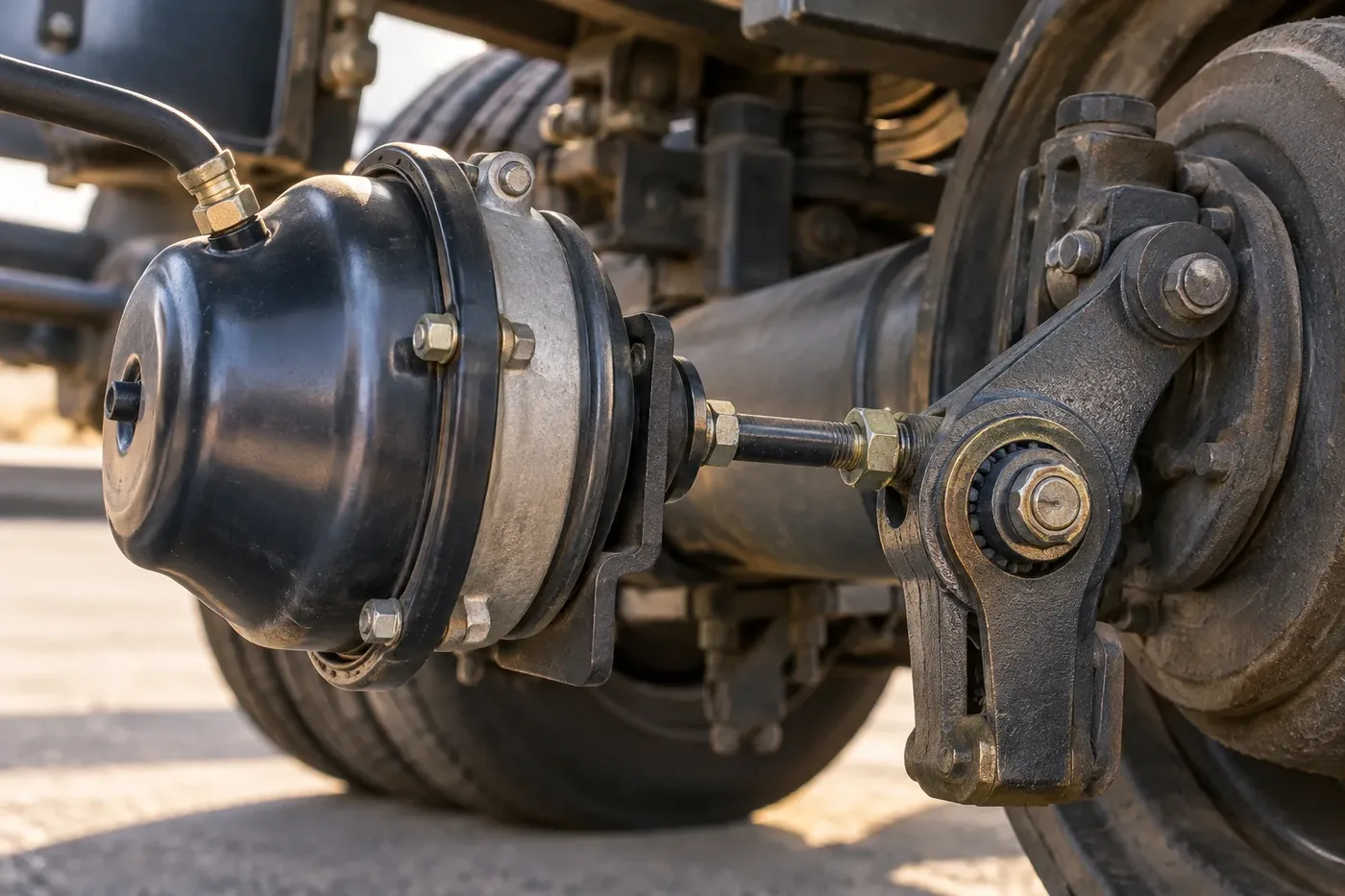
How an air-brake system works
Air brakes use compressed air instead of hydraulic fluid to apply braking force at the wheel. The compressor (driven by the engine) pumps air into the supply tank. The governor controls when the compressor pumps air: it cuts out at about 125 psi and cuts back in at about 100 psi. Air flows from the supply tank to the service tanks, then through the foot valve to the brake chambers. The brake chamber pushes a pushrod on the slack adjuster, which rotates the S-cam, which forces the brake shoes against the brake drum.
Dual systems
Trucks built since 1975 use a dual air-brake system: two separate systems (primary and secondary) sharing one set of controls. If one system loses pressure, the other still works. After starting the engine, wait until air pressure is at least 100 psi before driving. The low-pressure warning device must come on before pressure drops below 60 psi.
The seven-step air-brake check
(1) Test the parking brake by gently tugging against it in low gear. (2) Test service brakes: with air pressure built up, release the parking brake, move forward at 5 mph, and apply the brakes firmly — note any pulling or unusual feel. (3) Check air-loss rate: with the engine off, release service brakes and time the air-pressure drop — single vehicle: no more than 2 psi/min; combination: no more than 3 psi/min. (4) Apply firm brake-pedal pressure and check loss with brakes applied — single: no more than 3 psi/min; combination: no more than 4 psi/min. (5) Check that the low-pressure warning works (light/buzzer at or before 60 psi). (6) Continue fanning the brakes and check that the parking brake "pops out" between 20 and 45 psi. (7) Check that air pressure builds from 85 to 100 psi within 45 seconds in dual systems.
Spring brakes
Spring brakes are mechanical brakes held off by air pressure. When air pressure drops, large springs apply the brakes. They serve as both parking brake and emergency brake. Never drive with the parking brake on; never use the spring brakes if the service brakes are extremely hot (after a long downgrade).
Stopping technique
On long downgrades, select a low gear before starting down — not after — and use the engine and the brakes together with intermittent applications. The proper braking method on a downgrade: apply the brakes hard enough to feel a definite slowdown, then release when you are about 5 mph below your safe speed. Never "ride the brakes" continuously — they will overheat and fade.
ABS
Vehicles built after 1998 must have antilock braking systems. ABS does not shorten stopping distance under normal conditions; it lets you maintain steering control during emergency braking by preventing wheel lock-up. Brake the way you always would; if the ABS warning light stays on after start-up, the system is malfunctioning.
How to use this guide before your exam
Read each section carefully and try to put the rule in your own words before moving on. The CDL knowledge exam tests recognition more than recall — you'll see the right answer in front of you and have to pick it from distractors that all sound plausible. The way to defeat distractors is to know the underlying rule cold.
Once you can read this guide and answer "what's the rule?" without checking, return to the full practice test. If you score 85% or higher across two consecutive runs, you are ready to schedule the official knowledge test at your DMV.