South Dakota Air Brakes CDL Practice Test
This is a free 20-question practice test for the Air Brakes portion of the South Dakota Commercial Driver's License knowledge exam. Questions are pulled from a pool of 71 drawn from the AAMVA CDL Manual, which is the source document the South Dakota Driver Licensing Program uses to write its actual exam.
How it works: Click an answer. The correct choice highlights in green, and you'll see a short explanation. Aim for 85% or better before you sit for the real test in South Dakota.
Question 1 of 20
Air brakes take longer to work than hydraulic brakes because:
Correct. Brake-lag in air systems comes from the time air takes to travel through lines and reach all the brake chambers — typically 0.4 seconds added to perception/reaction time.
Question 2 of 20
Continuous use of the brakes on a long downgrade can cause:
Correct. Holding the brakes overheats them and causes brake fade — drums expand and brake compounds lose effectiveness, reducing braking force.
Question 3 of 20
You should perform a static air-leakage test by:
Correct. Engine off, brakes released, fully charged system: watch for air loss over one minute. Then apply brakes and check again.
Question 4 of 20
A condition called "brake fade" is most likely on:
Correct. Brake fade comes from heat from extended use — most commonly on long, steep downgrades where the brakes are working continuously.
Question 5 of 20
The spring brakes:
Correct. Spring brakes use heavy springs that apply the brake when air pressure is released or drops below 20-45 psi — they serve as both parking and emergency brake.
Question 6 of 20
The parts of an air-brake system include:
Correct. Air-brake systems use a compressor, governor, storage tanks, foot valve, and brake chambers — distinct from hydraulic systems used in cars.
Question 7 of 20
Manual slack adjusters must be adjusted:
Correct. Drivers may adjust manual slack adjusters in compliance with manufacturer specifications. Automatic slack adjusters are now standard but still require periodic checking.
Question 8 of 20
When should you NOT use the parking brakes?
Correct. Hot brakes can be damaged by the spring brakes contracting against hot drums. Let the brakes cool before parking.
Question 9 of 20
Air brakes are actually three brake systems combined:
Correct. A complete air-brake system has the service brake (foot valve), parking brake (spring/yellow knob), and emergency brake (which is the parking brake working off the spring brake when air drops).
Question 10 of 20
The supply pressure gauges show:
Correct. The supply (primary and secondary) pressure gauges show air pressure available for braking — a critical reading before driving and during operation.
Question 11 of 20
The air compressor is driven by:
Correct. The air compressor is engine-driven, typically through gears at the front of the engine or by a v-belt.
Question 12 of 20
Brake fade is the result of:
Correct. Brake fade comes from heat. Manage downgrade speed by gear selection plus intermittent firm brake use, not continuous light pressure.
Question 13 of 20
When the spring brakes apply automatically as air pressure drops, this typically happens between:
Correct. Spring brakes will fully apply somewhere between 20 and 45 psi as system pressure drops, depending on the vehicle.
Question 14 of 20
The S-cam:
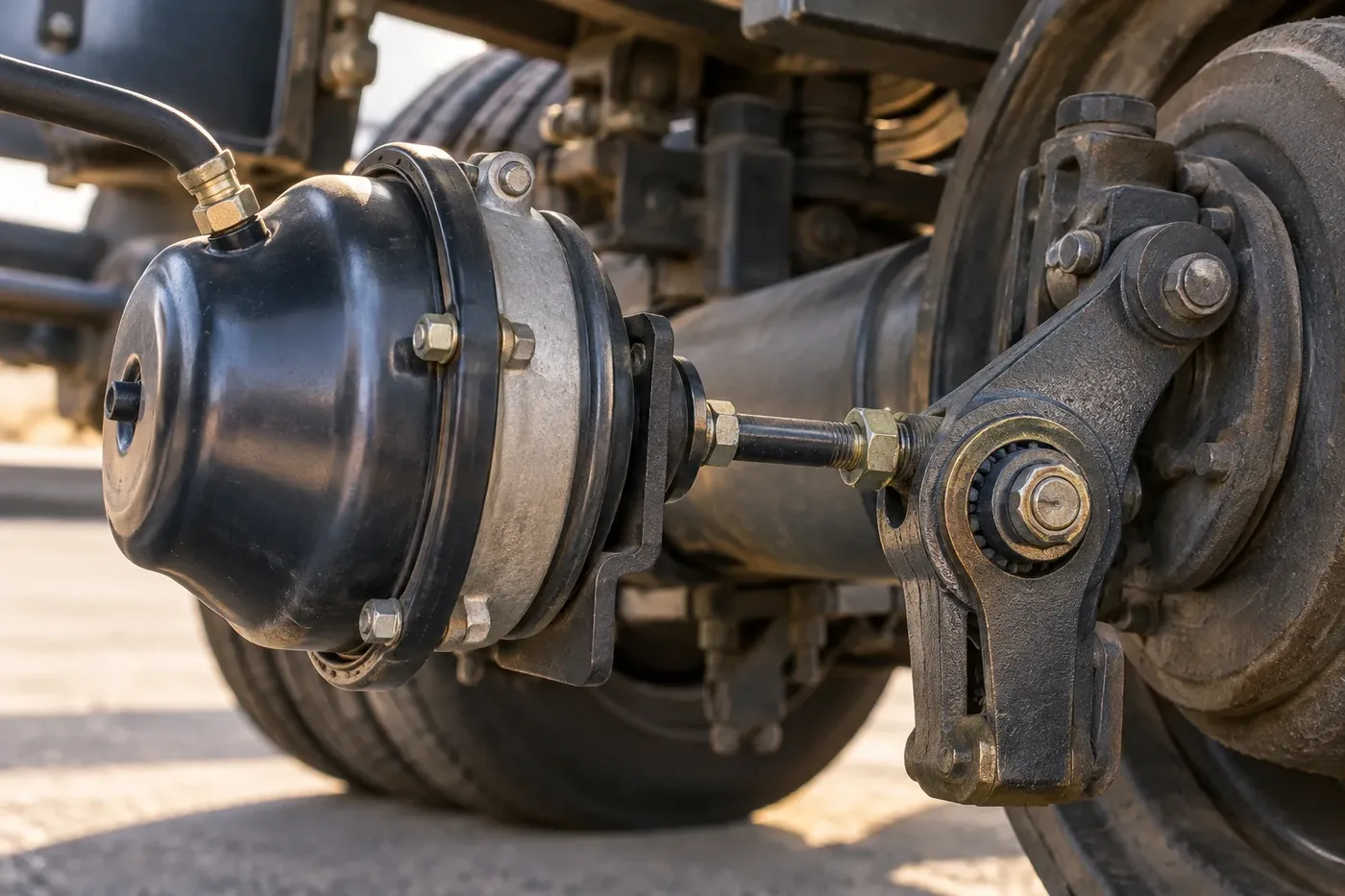
Correct. When the foot valve is pressed, air pushes the brake-chamber pushrod, which moves the slack adjuster, which rotates the S-cam shaft, forcing the shoes against the drum.
Question 15 of 20
In a dual air-brake system, you should let the air pressure build to at least what level before driving?
Correct. Wait until the system pressure is at least 100 psi before driving in a dual air-brake system.
Question 16 of 20
The governor controls:
Correct. The governor cycles the compressor: it cuts the compressor in around 100 psi and cuts it out around 125 psi.
Question 17 of 20
A yellow ABS malfunction lamp on the cab dash means:
Correct. A yellow ABS lamp on the dash indicates a tractor-ABS malfunction. The base brakes still work normally, but ABS is unavailable until repaired.
Question 18 of 20
Pre-trip air-brake check (Step 1) is to:
Correct. In the seven-step air-brake check the first step is testing the parking brake — release service brakes, set parking brake, gently try to move the vehicle in low gear.
Question 19 of 20
Wet brakes:
Correct. After fording water, brakes may be wet. Drive slowly while applying light brake pressure to dry them.
Question 20 of 20
Slack adjusters need to be checked because:
Correct. Slack adjusters control how far the pushrod must travel to apply the brake. Out-of-adjustment slack adjusters are the leading mechanical cause of out-of-service violations.
About the South Dakota Air Brakes exam
States typically administer 25 Air Brakes questions and require 80% to pass. Questions cover air-brake system parts, dual systems, supply pressure, brake-system warning, slack adjusters, the parking brake, the spring brake, the pre-trip air-system check, and the proper way to perform a leakage-rate test.
The South Dakota Driver Licensing Program follows the federal CDL standards established by FMCSA. To earn the Air Brakes credential, you must answer at least 80% of the questions correctly. Many candidates score lower the first time because the test pulls from a large pool — refreshing this page will give you a different mix of questions, drawn from the same authoritative source.
Want more practice? Try the full Air Brakes question bank or browse all South Dakota CDL practice tests.