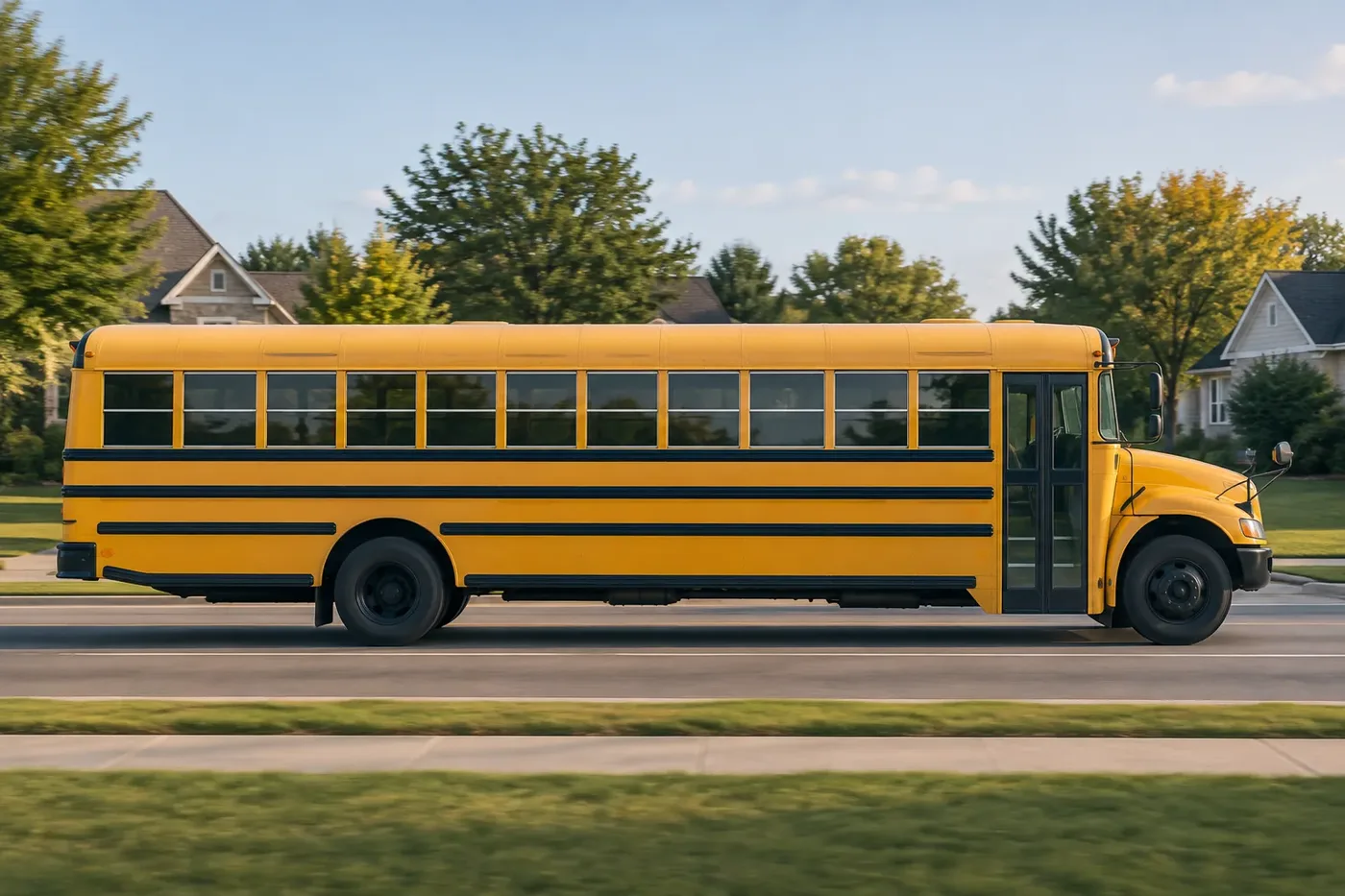
North Carolina School Bus CDL Practice Test
This is a free 20-question practice test for the School Bus portion of the North Carolina Commercial Driver's License knowledge exam. Questions are pulled from a pool of 55 drawn from the AAMVA CDL Manual, which is the source document the North Carolina Division of Motor Vehicles uses to write its actual exam.
How it works: Click an answer. The correct choice highlights in green, and you'll see a short explanation. Aim for 85% or better before you sit for the real test in North Carolina.
Question 1 of 20
When you encounter a railroad crossing without warning devices on a low-traffic spur:
Correct. Limited exceptions exist for industrial spurs and abandoned tracks. Always verify and prefer to stop when in doubt.
Question 2 of 20
Securing the bus at the end of the day:
Correct. Standard end-of-day securement: parking, brake, engine off, lights off, doors secured. Walk through to ensure no children remain.
Question 3 of 20
A student misbehaves on the bus. The driver should:
Correct. Pull off safely if behavior is dangerous to driving. Address calmly. Document and report per district policy. Never use physical force except to prevent immediate harm.
Question 4 of 20
A school bus driver should never:
Correct. Emergency exits are for emergencies. Routine use is unsafe and may damage the door or trigger interlocks.
Question 5 of 20
A school bus driver who notices fluid leaks during pre-trip:
Correct. Identify what is leaking. Brake-fluid, fuel, or coolant leaks render the bus unsafe. Repair before service.
Question 6 of 20
A school bus must have how many mirrors at minimum?
Correct. School buses have side mirrors plus crossover mirrors at the front so the driver can see the danger zone in front of the bus and on the right.
Question 7 of 20
Speed limits in school zones apply to a school bus driver:
Correct. School-zone limits apply to school-bus operators just as to other drivers; observe posted reduced limits when in effect.
Question 8 of 20
A school bus stopped on a highway during loading or unloading is protected by:
Correct. State laws (informed by federal recommendations) require approaching vehicles to stop. Many states have stiff fines for passing a stopped school bus.
Question 9 of 20
If you must evacuate students through the rear emergency exit:
Correct. Position helpers at exits to assist. Maintain orderly process. Account for all students at the safe area.
Question 10 of 20
When you cannot account for all students after unloading:
Correct. Missing student requires immediate search. Stop, brake, search the bus and the area around it before continuing.
Question 11 of 20
A school bus stop in low-light or poor-visibility conditions:
Correct. Reduced visibility means earlier flashers, more conspicuous stop, more time for traffic to react.
Question 12 of 20
After delivering students to school in the morning:
Correct. Walk every aisle, every seat. Confirm bus is empty before leaving for the day or for the next trip.
Question 13 of 20
When backing a school bus, you should:
Correct. Backing in a school bus is the highest-risk maneuver. Avoid it. If required, use a helper, sound the horn, do not back across roadways, and ideally do not back with students aboard.
Question 14 of 20
When the bus must stop because of crossing students, you should also:
Correct. The crossing-control arm extends in front of the bus, forcing students to walk where the driver can see them.
Question 15 of 20
The "danger zone" around a school bus is generally:
Correct. The danger zone extends 10 feet in front, 10 feet on each side, and 10 feet behind the bus, plus the area needed to maneuver. Most students killed by their own bus are in this zone.
Question 16 of 20
When a bus is in motion, students must:
Correct. Seated, facing forward, hands and feet to themselves, aisle clear. This protects them in any sudden stop.
Question 17 of 20
The school bus stop arm:
Correct. The stop arm signals approaching traffic to stop. Drivers who pass a stopped school bus with red lights flashing face heavy fines.
Question 18 of 20
When loading students at the stop, the driver should:
Correct. Count students before, during, and after loading. Late students may approach in your blind spot.
Question 19 of 20
A school bus with red lights flashing and stop arm extended:
Correct. Red flashers + stop arm = required stop for approaching traffic in both directions (with the divided-highway exception in some states).
Question 20 of 20
When you approach a railroad crossing in a school bus, you must stop:
Correct. Stop 15 to 50 feet from the nearest rail, open door and driver window, look and listen, then proceed without shifting gears.
About the North Carolina School Bus exam
Most states administer 20 School Bus questions and require 80% to pass. The exam emphasizes loading and unloading procedures, the danger zone around the bus, emergency exit and evacuation procedures, railroad-highway crossings, and student management.
The North Carolina Division of Motor Vehicles follows the federal CDL standards established by FMCSA. To earn the School Bus credential, you must answer at least 80% of the questions correctly. Many candidates score lower the first time because the test pulls from a large pool — refreshing this page will give you a different mix of questions, drawn from the same authoritative source.
Want more practice? Try the full School Bus question bank or browse all North Carolina CDL practice tests.