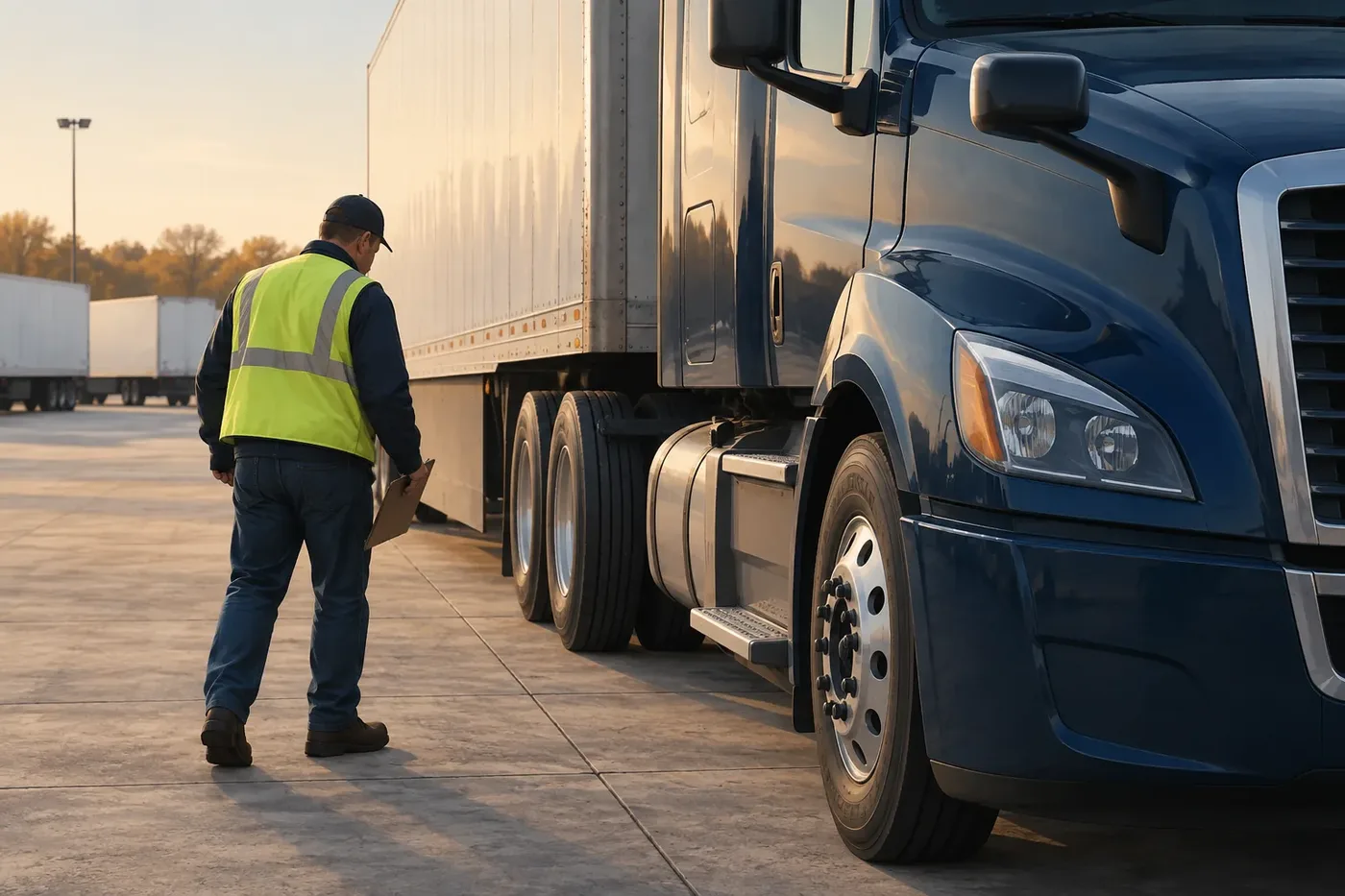
New Jersey General Knowledge CDL Practice Test
This is a free 20-question practice test for the General Knowledge portion of the New Jersey Commercial Driver's License knowledge exam. Questions are pulled from a pool of 97 drawn from the AAMVA CDL Manual, which is the source document the New Jersey Motor Vehicle Commission uses to write its actual exam.
How it works: Click an answer. The correct choice highlights in green, and you'll see a short explanation. Aim for 85% or better before you sit for the real test in New Jersey.
Question 1 of 20
What is the minimum tread depth required for the front (steering) tires of a commercial vehicle?
Correct. Steer-axle tires must have at least 4/32-inch tread depth in every major groove. Other tires require at least 2/32 inch.
Question 2 of 20
Empty trucks:
Correct. An empty truck has lighter axle weight, so the brakes generate less friction relative to vehicle weight — the truck can take longer to stop than the same vehicle loaded.
Question 3 of 20
A "controlled braking" stop is:
Correct. Controlled braking applies the brakes as hard as you can without locking the wheels — used in emergency stops on non-ABS vehicles to retain steering.
Question 4 of 20
How often must drivers inspect their cargo and securing devices?
Correct. Federal rule: inspect within the first 50 miles, then every 150 miles or 3 hours of driving, whichever comes first, plus every change of duty status.
Question 5 of 20
When should you place reflective triangles on a divided highway after stopping due to a breakdown?
Correct. On a divided highway with traffic from one direction, place triangles 10, 100, and 200 feet behind the vehicle, on the shoulder or in the lane you stopped in.
Question 6 of 20
Which of these is a sign of tire failure?
Correct. Vibration, a loud bang from a blowout, and pulling to one side are all classic signs of tire failure.
Question 7 of 20
How many red reflective triangles must you carry in your commercial vehicle for emergency warning?
Correct. You must carry three red reflective triangles, six fusees, or three liquid-burning flares for emergency warning use.
Question 8 of 20
You are driving a 40-foot vehicle at 35 mph. The minimum following distance you should maintain is:
Correct. The rule of thumb: 1 second per 10 feet of vehicle length below 40 mph. A 40-foot vehicle therefore needs 4 seconds of following distance.
Question 9 of 20
Which lane is generally the best for a commercial vehicle on a multi-lane highway?
Correct. The right lane is generally best — it limits lane changes, reduces conflict with merging traffic only on the right, and matches commercial-vehicle speed.
Question 10 of 20
When the engine is running in the cab inspection, you should check:
Correct. After starting, watch the gauges to be sure all systems are operating normally before you drive.
Question 11 of 20
You are driving on a two-lane road. An oncoming driver drifts into your lane. You should:
Correct. When an oncoming driver drifts into your lane, the safer escape is right onto the shoulder. Steering left risks a head-on if the other driver corrects.
Question 12 of 20
Which of these is true about driving in fog?
Correct. In fog, high beams reflect off water particles and impair vision. Use low beams. Many drivers also use four-way flashers when moving slowly to alert traffic.
Question 13 of 20
When you double your speed from 20 to 40 mph, the impact in a crash is:
Correct. Crash energy is proportional to the square of speed. Doubling speed quadruples the energy of impact.
Question 14 of 20
A driver who has been disqualified is:
Correct. A disqualified driver may not operate a commercial motor vehicle on public roads, regardless of supervision.
Question 15 of 20
Which of the following is NOT part of the seven-step pre-trip inspection method?
Correct. The radio is not part of the safety inspection. The seven-step method covers approach, engine compartment, in-cab checks, lights, walk-around, signal lights, and brake checks.
Question 16 of 20
If your vehicle hydroplanes, what should you do?
Correct. Release the accelerator and push in the clutch. Do not brake or steer hard until the tires regain contact.
Question 17 of 20
Hydroplaning is most likely to occur when:
Correct. Hydroplaning occurs when a film of water comes between the tires and the road, causing the tires to lose contact with the pavement. Higher speeds, worn tires, and standing water increase the risk.
Question 18 of 20
Which of the following is a good way to avoid hydroplaning?
Correct. Slowing down reduces the chance of hydroplaning. Maintain proper tire inflation and tread depth, and avoid using cruise control on wet roads.
Question 19 of 20
Cargo should be secured so that it does not shift:
Correct. Federal cargo-securement rules require that cargo not shift in any direction during normal driving conditions, including emergency braking.
Question 20 of 20
Which of the following is the best way to prevent a fire in your vehicle?
Correct. Most fires are preventable through inspection (electrical, fuel-system, tire) and watching gauges, plus prohibiting smoking near fuel and observing safe loading/refueling rules.
About the New Jersey General Knowledge exam
Most state DMVs administer 50 General Knowledge questions and require 80% (40 correct) to pass. Questions are pulled from a much larger pool, so two applicants taking the test on the same day will see different mixes. The questions on this site are drawn from the AAMVA CDL Manual chapters that every state's exam is built from.
The New Jersey Motor Vehicle Commission follows the federal CDL standards established by FMCSA. To earn the General Knowledge credential, you must answer at least 80% of the questions correctly. Many candidates score lower the first time because the test pulls from a large pool — refreshing this page will give you a different mix of questions, drawn from the same authoritative source.
Want more practice? Try the full General Knowledge question bank or browse all New Jersey CDL practice tests.