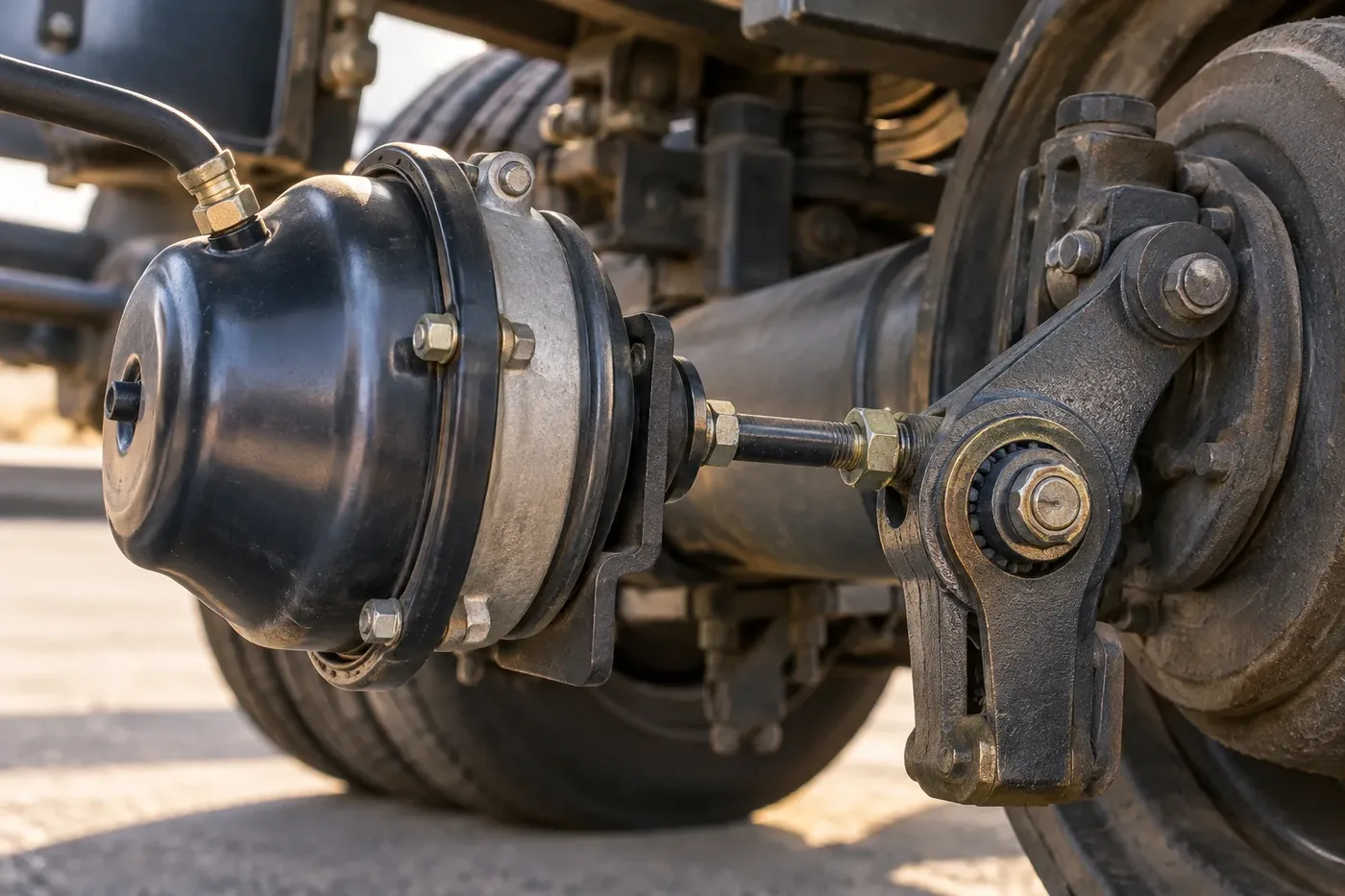
New Jersey Air Brakes CDL Practice Test
This is a free 20-question practice test for the Air Brakes portion of the New Jersey Commercial Driver's License knowledge exam. Questions are pulled from a pool of 71 drawn from the AAMVA CDL Manual, which is the source document the New Jersey Motor Vehicle Commission uses to write its actual exam.
How it works: Click an answer. The correct choice highlights in green, and you'll see a short explanation. Aim for 85% or better before you sit for the real test in New Jersey.
Question 1 of 20
In a dual air-brake system, the time required for air pressure to build from 85 to 100 psi should be no more than:
Correct. In dual air-brake systems, air should build from 85 to 100 psi within 45 seconds at engine governed RPM.
Question 2 of 20
Continuous use of the brakes on a long downgrade can cause:
Correct. Holding the brakes overheats them and causes brake fade — drums expand and brake compounds lose effectiveness, reducing braking force.
Question 3 of 20
The "brake-system warning device" must come on no later than:
Correct. A federal-rule low-air-pressure warning device must activate at or before 60 psi.
Question 4 of 20
The air compressor is driven by:
Correct. The air compressor is engine-driven, typically through gears at the front of the engine or by a v-belt.
Question 5 of 20
The brake-system warning light or buzzer is designed to alert you when:
Correct. The brake-system warning device alerts you to dangerous low air pressure — typically activating at or before 60 psi.
Question 6 of 20
In a fully charged dual air-brake system at idle, you should test the low-pressure warning by:
Correct. Engine off, fan the brake pedal to bleed pressure. The low-pressure warning device should activate before pressure drops below 60 psi.
Question 7 of 20
When brake drums or shoes get very hot, you should:
Correct. Park where you can let the brakes cool. Do not apply the parking (spring) brake on overheated brakes — it can damage them or cause warpage.
Question 8 of 20
Which of these is the safest speed for descending a long, steep grade?
Correct. Choose a speed and gear that lets the brakes work intermittently without continuous pressure. Posted truck-grade signs help.
Question 9 of 20
You hear a steady "ssss" sound while parked with the engine off. This is most likely:
Correct. A steady hiss with the engine off indicates an air leak — find and repair before driving.
Question 10 of 20
If you must drive a vehicle with manual front-wheel-brake limiting valve, you should keep it in the "normal" position:
Correct. Keep the front-wheel limiting valve in the "normal" position. Modern trucks rarely have this valve, but if equipped, leaving it in "slippery" reduces front braking and lengthens stopping distance.
Question 11 of 20
Total stopping distance with air brakes equals:
Correct. Add brake-lag distance to the standard perception + reaction + braking distance for any vehicle with air brakes.
Question 12 of 20
A yellow ABS malfunction lamp on the cab dash means:
Correct. A yellow ABS lamp on the dash indicates a tractor-ABS malfunction. The base brakes still work normally, but ABS is unavailable until repaired.
Question 13 of 20
You should test the parking brake by:
Correct. After applying the parking brake and releasing the service brakes, gently try to move forward in low gear. If the vehicle moves, the parking brake is not holding.
Question 14 of 20
A long downgrade requires:
Correct. Pick a low gear before starting down. Use the brakes in firm, intermittent applications: brake to 5 mph below safe speed, release, repeat.
Question 15 of 20
In an emergency stop on a non-ABS vehicle, you should:
Correct. Stab braking applies brakes hard until the wheels lock, then releases when you feel skid — this slows the vehicle while keeping it straight.
Question 16 of 20
You should never leave the vehicle unattended without:
Correct. Set the parking brake. On grades or where unintended movement could occur, chock the wheels in addition.
Question 17 of 20
The supply pressure gauges show:
Correct. The supply (primary and secondary) pressure gauges show air pressure available for braking — a critical reading before driving and during operation.
Question 18 of 20
Air loss from the brake system on a moving combination vehicle, with brakes applied, should not exceed:
Correct. Combination vehicle, brakes applied, engine off: no more than 4 psi/min air loss. Engine off, brakes released: no more than 3 psi/min.
Question 19 of 20
The governor controls:
Correct. The governor cycles the compressor: it cuts the compressor in around 100 psi and cuts it out around 125 psi.
Question 20 of 20
When releasing brakes after a hard stop, you should:
Correct. Release the brakes smoothly. Air tanks refill while you drive; allow the compressor to recharge the system before the next braking event.
About the New Jersey Air Brakes exam
States typically administer 25 Air Brakes questions and require 80% to pass. Questions cover air-brake system parts, dual systems, supply pressure, brake-system warning, slack adjusters, the parking brake, the spring brake, the pre-trip air-system check, and the proper way to perform a leakage-rate test.
The New Jersey Motor Vehicle Commission follows the federal CDL standards established by FMCSA. To earn the Air Brakes credential, you must answer at least 80% of the questions correctly. Many candidates score lower the first time because the test pulls from a large pool — refreshing this page will give you a different mix of questions, drawn from the same authoritative source.
Want more practice? Try the full Air Brakes question bank or browse all New Jersey CDL practice tests.