Nevada Air Brakes CDL Practice Test
This is a free 20-question practice test for the Air Brakes portion of the Nevada Commercial Driver's License knowledge exam. Questions are pulled from a pool of 71 drawn from the AAMVA CDL Manual, which is the source document the Nevada Department of Motor Vehicles uses to write its actual exam.
How it works: Click an answer. The correct choice highlights in green, and you'll see a short explanation. Aim for 85% or better before you sit for the real test in Nevada.
Question 1 of 20
You should check the air-system pressure build-up time during pre-trip:
Correct. In dual air-brake systems, the air should build from 85 to 100 psi within 45 seconds with the engine at governed RPM.
Question 2 of 20
You hear a steady "ssss" sound while parked with the engine off. This is most likely:
Correct. A steady hiss with the engine off indicates an air leak — find and repair before driving.
Question 3 of 20
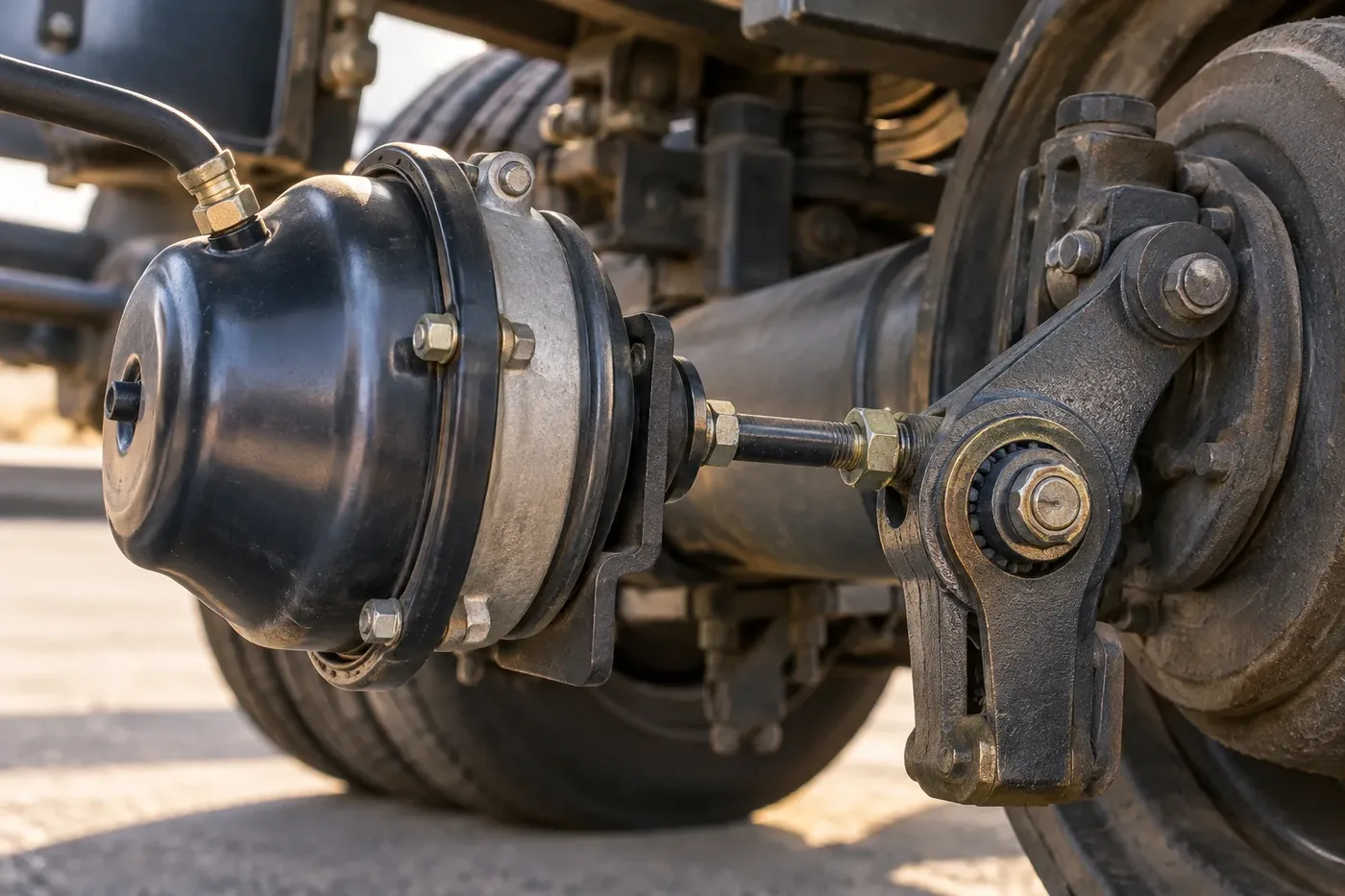
The S-cam:
Correct. When the foot valve is pressed, air pushes the brake-chamber pushrod, which moves the slack adjuster, which rotates the S-cam shaft, forcing the shoes against the drum.
Question 4 of 20
The supply pressure gauges show:
Correct. The supply (primary and secondary) pressure gauges show air pressure available for braking — a critical reading before driving and during operation.
Question 5 of 20
During a brake check, the brake pedal should not move more than ___ when you push it down hard with the engine off and air pressure built up:
Correct. After full charge, holding the foot valve down should produce a firm pedal that moves only a few inches. Pedal sinking to the floor indicates a leak.
Question 6 of 20
When the spring brakes apply automatically as air pressure drops, this typically happens between:
Correct. Spring brakes will fully apply somewhere between 20 and 45 psi as system pressure drops, depending on the vehicle.
Question 7 of 20
In a dual air-brake system, the time required for air pressure to build from 85 to 100 psi should be no more than:
Correct. In dual air-brake systems, air should build from 85 to 100 psi within 45 seconds at engine governed RPM.
Question 8 of 20
The application pressure gauge shows:
Correct. The application gauge (when present) shows brake-application pressure — useful for spotting brake-system problems on long downgrades.
Question 9 of 20
The spring brakes:
Correct. Spring brakes use heavy springs that apply the brake when air pressure is released or drops below 20-45 psi — they serve as both parking and emergency brake.
Question 10 of 20
A condition called "brake fade" is most likely on:
Correct. Brake fade comes from heat from extended use — most commonly on long, steep downgrades where the brakes are working continuously.
Question 11 of 20
Modern trucks have ABS that is required on:
Correct. Federal rule: tractors built after March 1, 1997, and trailers and single-unit air-braked vehicles after March 1, 1998, must have ABS.
Question 12 of 20
A low-air-pressure warning device must come on at or before:
Correct. A federal-mandated low-air-pressure warning (light, buzzer, or wig-wag) must activate at or before 60 psi.
Question 13 of 20
The parking-brake control:
Correct. The parking-brake control is a yellow diamond-shaped knob, distinct from the red round trailer-supply knob.
Question 14 of 20
Continuous use of the brakes on a long downgrade can cause:
Correct. Holding the brakes overheats them and causes brake fade — drums expand and brake compounds lose effectiveness, reducing braking force.
Question 15 of 20
You are driving a fully loaded combination vehicle on a steep downgrade. Your safe speed is 30 mph and you have already shifted to a lower gear. The proper braking technique is to:
Correct. The "snub-and-release" method: brake firmly to drop 5 mph below safe speed, release until safe speed returns, repeat. Holding the brakes overheats them.
Question 16 of 20
Total stopping distance with air brakes equals:
Correct. Add brake-lag distance to the standard perception + reaction + braking distance for any vehicle with air brakes.
Question 17 of 20
Pre-trip air-brake check (Step 1) is to:
Correct. In the seven-step air-brake check the first step is testing the parking brake — release service brakes, set parking brake, gently try to move the vehicle in low gear.
Question 18 of 20
Slack adjusters need to be checked because:
Correct. Slack adjusters control how far the pushrod must travel to apply the brake. Out-of-adjustment slack adjusters are the leading mechanical cause of out-of-service violations.
Question 19 of 20
For a single vehicle with engine off and brakes applied, the maximum allowable air-loss rate is:
Correct. A single vehicle is allowed no more than 3 psi/min with brakes fully applied.
Question 20 of 20
A long downgrade requires:
Correct. Pick a low gear before starting down. Use the brakes in firm, intermittent applications: brake to 5 mph below safe speed, release, repeat.
About the Nevada Air Brakes exam
States typically administer 25 Air Brakes questions and require 80% to pass. Questions cover air-brake system parts, dual systems, supply pressure, brake-system warning, slack adjusters, the parking brake, the spring brake, the pre-trip air-system check, and the proper way to perform a leakage-rate test.
The Nevada Department of Motor Vehicles follows the federal CDL standards established by FMCSA. To earn the Air Brakes credential, you must answer at least 80% of the questions correctly. Many candidates score lower the first time because the test pulls from a large pool — refreshing this page will give you a different mix of questions, drawn from the same authoritative source.
Want more practice? Try the full Air Brakes question bank or browse all Nevada CDL practice tests.