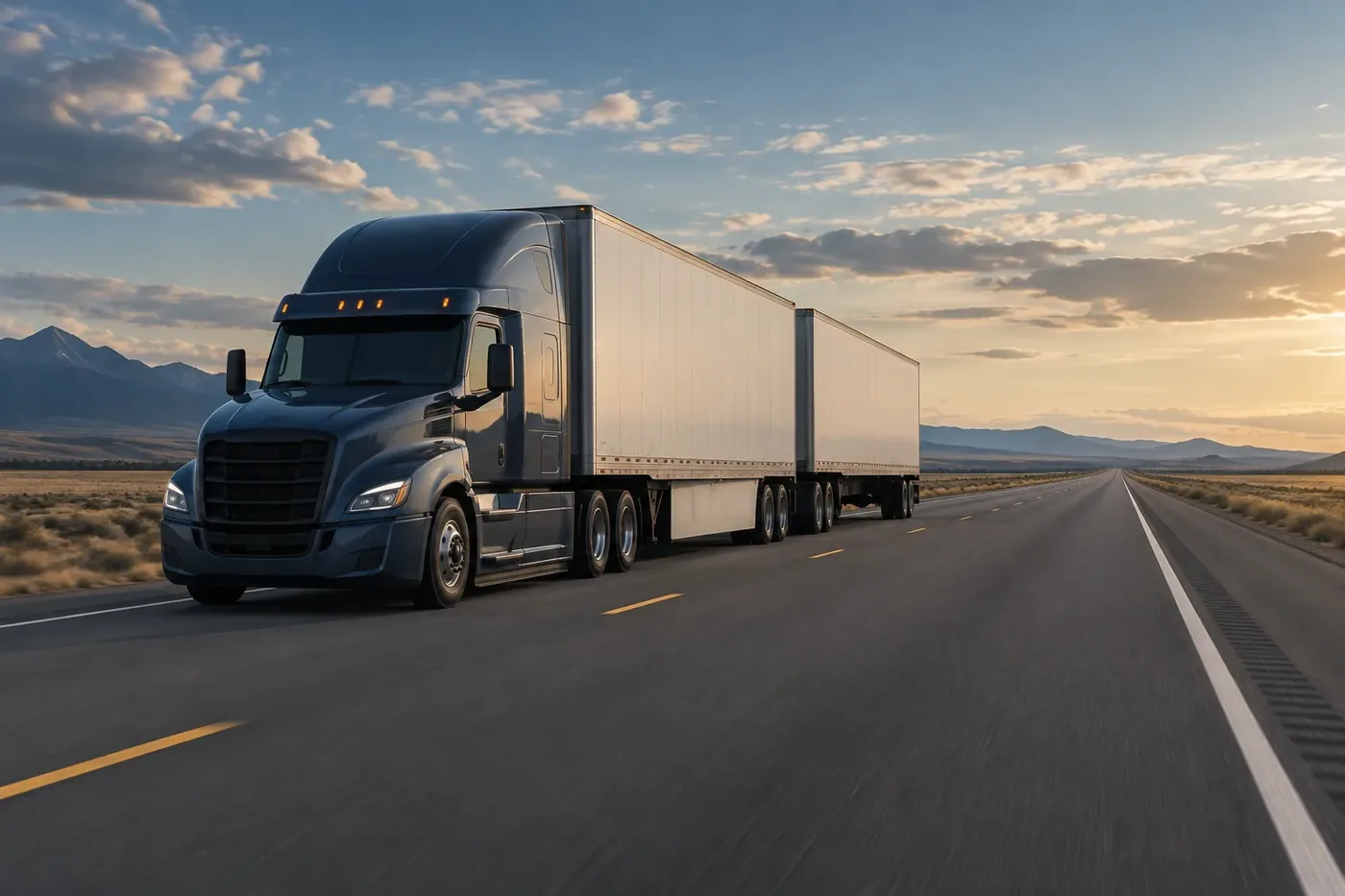
Nebraska Doubles/Triples CDL Practice Test
This is a free 20-question practice test for the Doubles/Triples portion of the Nebraska Commercial Driver's License knowledge exam. Questions are pulled from a pool of 50 drawn from the AAMVA CDL Manual, which is the source document the Nebraska Department of Motor Vehicles uses to write its actual exam.
How it works: Click an answer. The correct choice highlights in green, and you'll see a short explanation. Aim for 85% or better before you sit for the real test in Nebraska.
Question 1 of 20
A tractor pulling doubles cannot brake as quickly as a tractor pulling a single trailer because:
Correct. Greater weight and longer air lines mean longer braking distance. Plan stopping distance with extra margin.
Question 2 of 20
Driving doubles or triples on the highway:
Correct. Multi-trailer rigs are more sensitive to abrupt steering, take longer to brake, and amplify any movement to the rear. Be gentle and plan ahead.
Question 3 of 20
Air pressure on a triple-trailer rig takes:
Correct. Each additional trailer adds line length. Brake response at the rear trailer of a triple is noticeably delayed — brake earlier.
Question 4 of 20
A "set of triples" typically refers to:
Correct. A set of triples is one tractor pulling three trailers — usually allowed only on specific designated routes.
Question 5 of 20
You discover a flat tire on the rear trailer of a triple. You should:
Correct. A flat tire affects rig stability and brake load. Pull off safely, use warning devices, and address the tire.
Question 6 of 20
When pulling doubles in a tunnel:
Correct. Tunnel clearance can be tight for long doubles — watch overhead and side clearance, and respect any vehicle-class restrictions.
Question 7 of 20
A "drive-axle skid" on a doubles rig:
Correct. A drive-axle skid leads to tractor jackknife. With trailers behind, the situation gets worse fast — the rear trailers can swing wildly.
Question 8 of 20
When pulling a heavy lead trailer and a light second trailer, the rig:
Correct. Heaviest in front, lightest in rear. Heavy at the rear amplifies crack-the-whip and rollover risk.
Question 9 of 20
When backing a doubles or triples combination:
Correct. Doubles and triples cannot be backed safely beyond a few feet — joints flex unpredictably. Plan your route and parking to avoid backing.
Question 10 of 20
On a steep downgrade with doubles, you should:
Correct. Same rule as any combination vehicle, but plan extra margin: doubles take longer to stop and the rear trailer may push.
Question 11 of 20
When pulling a single trailer and trying to figure out if you should add a doubles endorsement:
Correct. The T endorsement is required only when you actually operate doubles or triples. Single-trailer operations do not require it.
Question 12 of 20
An empty rear trailer on a multi-trailer rig:
Correct. Lighter trailer = more vulnerable to crack-the-whip and crosswinds. Empty rear trailers in multi-trailer rigs roll easily.
Question 13 of 20
A doubles rig is more likely to roll over than a single because:
Correct. Multi-trailer rollover comes from rearward amplification — even modest steering input at the tractor becomes a violent swing at the rear trailer.
Question 14 of 20
When parking a doubles rig:
Correct. Choose pull-through parking. Multi-trailer rigs cannot back any meaningful distance safely.
Question 15 of 20
Coupling order for a set of doubles starts with:
Correct. Standard order: tractor + lead trailer first, charge air, then attach converter dolly behind lead trailer, then second trailer to dolly.
Question 16 of 20
A driver licensed for Class A with all endorsements may drive any combination vehicle. The T endorsement allows:
Correct. T endorsement specifically authorizes doubles and triples. Other endorsements (H, N, P, S) cover other categories.
Question 17 of 20
When you encounter a breakaway in your doubles (a trailer separates):
Correct. Maintain control of what remains, brake gently and progressively, secure the area with warning devices, contact dispatch.
Question 18 of 20
A "doubles" combination uses a tractor plus:
Correct. Doubles = tractor + lead semi-trailer + converter dolly + second semi-trailer (which becomes a full trailer once on the dolly).
Question 19 of 20
The "T" endorsement is required to:
Correct. The T endorsement is required to pull more than one trailer (doubles or triples).
Question 20 of 20
Drivers should always couple the heaviest trailer:
Correct. Heaviest trailer goes directly behind the tractor; lightest goes at the rear. This minimizes rearward amplification and rollover risk.
About the Nebraska Doubles/Triples exam
Most states administer 20 Doubles/Triples questions and require 80% to pass. The exam emphasizes coupling and uncoupling the converter dolly, rearward amplification (the "crack-the-whip" effect), and the unique inspection and handling demands of multi-trailer rigs.
The Nebraska Department of Motor Vehicles follows the federal CDL standards established by FMCSA. To earn the Doubles/Triples credential, you must answer at least 80% of the questions correctly. Many candidates score lower the first time because the test pulls from a large pool — refreshing this page will give you a different mix of questions, drawn from the same authoritative source.
Want more practice? Try the full Doubles/Triples question bank or browse all Nebraska CDL practice tests.