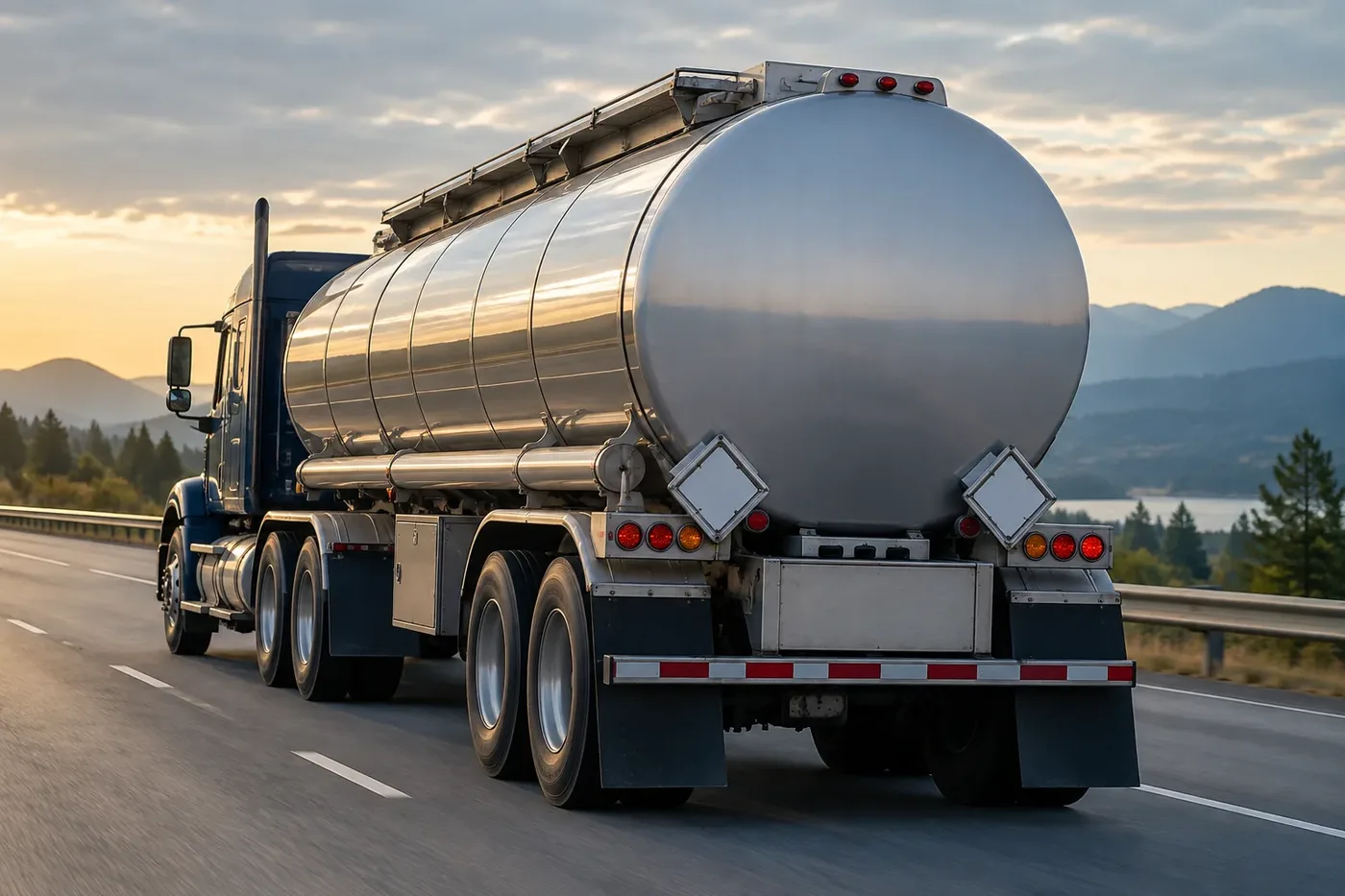
Montana Hazmat CDL Practice Test
This is a free 20-question practice test for the Hazmat portion of the Montana Commercial Driver's License knowledge exam. Questions are pulled from a pool of 68 drawn from the AAMVA CDL Manual, which is the source document the Montana Motor Vehicle Division uses to write its actual exam.
How it works: Click an answer. The correct choice highlights in green, and you'll see a short explanation. Aim for 85% or better before you sit for the real test in Montana.
Question 1 of 20
Placards must be displayed on:
Correct. Placards are displayed on all four sides of the vehicle — front, back, and both sides.
Question 2 of 20
Hazard Class 8 is:
Correct. Class 8 is corrosive materials — sulfuric acid, sodium hydroxide, hydrochloric acid, etc.
Question 3 of 20
Hazardous materials are products that:
Correct. Hazardous materials (hazmat) are products that pose a risk to health, safety, or property during transportation. Hazmat regulations are codified in 49 CFR.
Question 4 of 20
When loading a vehicle with hazardous materials, you should:
Correct. Set the parking brake, chock wheels of cargo tank vehicles, and shut off the engine before loading or unloading flammables.
Question 5 of 20
A vehicle hauling explosives may not be parked within:
Correct. Class 1 explosives have specific parking restrictions — at least 300 feet from open fires; never near schools, theaters, or places where people gather.
Question 6 of 20
A "bulk packaging" generally refers to:
Correct. Bulk packaging exceeds 119 gallons (liquid), 882 lbs (solid), or 1,000 lbs (gas). Bulk packaging requires markings, the four-digit ID number on each side and end, and additional driver-training requirements.
Question 7 of 20
Hazard Class 3 is:
Correct. Class 3 is flammable liquids — gasoline, diesel, ethanol, alcohols, etc.
Question 8 of 20
A driver's responsibilities for hazmat include:
Correct. The driver verifies the shipment, placards if required, carries the documentation, follows routes and parking rules, and handles incidents per training.
Question 9 of 20
When a hazmat shipment crosses international borders:
Correct. Cross-border hazmat may require documentation in compliance with both jurisdictions, plus customs paperwork.
Question 10 of 20
A driver is required to carry an ERG (or equivalent) when:
Correct. Whenever hazmat is being transported, the driver must have access to current ERG information for the materials in question.
Question 11 of 20
Subsidiary risk labels on a package indicate:
Correct. Some materials have multiple hazards. The primary hazard is shown on the top-class label; subsidiary risks (e.g., toxic AND flammable) are shown on additional labels.
Question 12 of 20
A "DANGEROUS" placard may be used:
Correct. When more than two Table 2 materials are aboard with combined weight over 1,001 lbs (none over 2,205 lbs at one stop), a single DANGEROUS placard may substitute.
Question 13 of 20
Placards are required when:
Correct. Table 1 materials always require placards (any amount). Table 2 materials require placards when 1,001 pounds or more of any combination is loaded.
Question 14 of 20
Bulk packaging of certain corrosives requires:
Correct. Bulk packaging of corrosives, like other hazmat, requires shipping name on the sides and ID-number marking on each side and end.
Question 15 of 20
Who is responsible for proper hazmat packaging and labeling?
Correct. The shipper packages, labels, and certifies the materials. The carrier and driver verify and refuse non-compliant shipments.
Question 16 of 20
You should never smoke or carry an open flame near hazmat that is:
Correct. Smoking or open flames are dangerous near explosives, flammable gases, flammable liquids, and oxidizers. The 25-foot rule applies during loading.
Question 17 of 20
The Hazardous Materials Table (HMT) lists:
Correct. The HMT in 49 CFR §172.101 lists every hazardous material with its proper shipping name, hazard class, identification number, packing group, label requirements, and special provisions.
Question 18 of 20
Class 1.1, 1.2, or 1.3 explosives must be parked:
Correct. Division 1.1, 1.2, and 1.3 explosives, and Division 2.3 or 6.1 PIH cargo, must have an attended-vehicle (qualified person within 100 feet, awake, able to see the vehicle).
Question 19 of 20
A leaking package of hazmat:
Correct. Never transport a leaking package. Secure the area, report to the carrier, contact emergency services if the leak poses immediate danger.
Question 20 of 20
Hazard Class 1 is:
Correct. Class 1 covers explosives, divided into divisions 1.1 through 1.6 by mass-explosion and projection hazard.
About the Montana Hazmat exam
Most states administer 30 Hazmat questions and require 80% to pass. The exam covers hazard classes, the shipping paper, placards and labels, loading and unloading, driving and parking rules, emergency response, and the Emergency Response Guidebook (ERG).
The Montana Motor Vehicle Division follows the federal CDL standards established by FMCSA. To earn the Hazmat credential, you must answer at least 80% of the questions correctly. Many candidates score lower the first time because the test pulls from a large pool — refreshing this page will give you a different mix of questions, drawn from the same authoritative source.
Want more practice? Try the full Hazmat question bank or browse all Montana CDL practice tests.