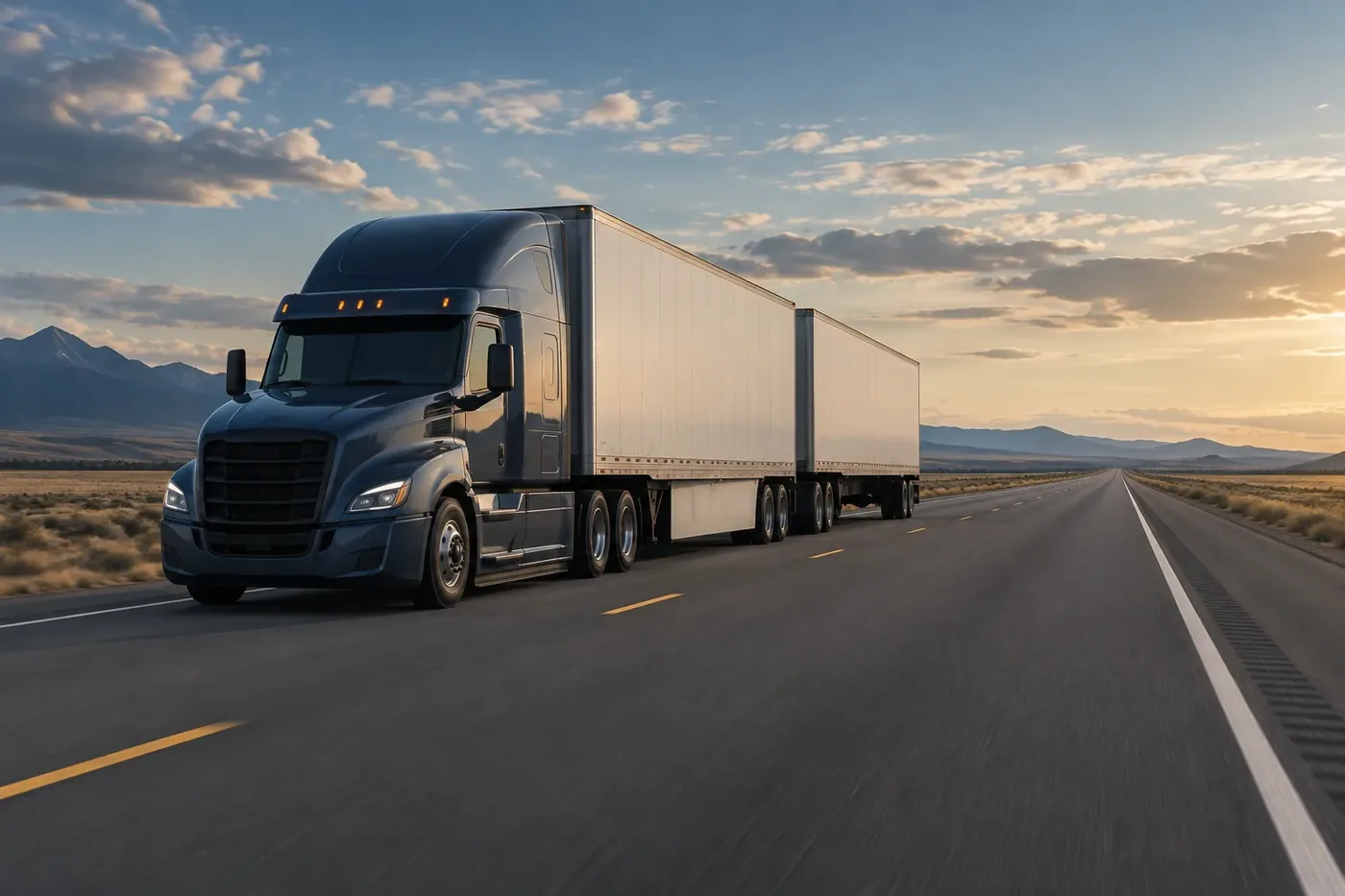
Missouri Doubles/Triples CDL Practice Test
This is a free 20-question practice test for the Doubles/Triples portion of the Missouri Commercial Driver's License knowledge exam. Questions are pulled from a pool of 50 drawn from the AAMVA CDL Manual, which is the source document the Missouri Department of Revenue Driver License Bureau uses to write its actual exam.
How it works: Click an answer. The correct choice highlights in green, and you'll see a short explanation. Aim for 85% or better before you sit for the real test in Missouri.
Question 1 of 20
Drivers should always couple the heaviest trailer:
Correct. Heaviest trailer goes directly behind the tractor; lightest goes at the rear. This minimizes rearward amplification and rollover risk.
Question 2 of 20
When you uncouple a converter dolly, you should:
Correct. Park level, disconnect air and electric, lower trailer landing gear if applicable, remove safety chains, then release the pintle hook to free the dolly.
Question 3 of 20
A "set of triples" typically refers to:
Correct. A set of triples is one tractor pulling three trailers — usually allowed only on specific designated routes.
Question 4 of 20
Doubles and triples should not be driven:
Correct. On slippery roads, multi-trailer rigs lose stability quickly. Reduce speed substantially and increase following distance.
Question 5 of 20
During a pre-trip on doubles, the trailer-supply line:
Correct. The supply line carries air from tractor through every trailer; verify open valves at every coupled connection and a closed valve at the rear of the rear-most trailer.
Question 6 of 20
An empty rear trailer on a multi-trailer rig:
Correct. Lighter trailer = more vulnerable to crack-the-whip and crosswinds. Empty rear trailers in multi-trailer rigs roll easily.
Question 7 of 20
When pulling a heavy lead trailer and a light second trailer, the rig:
Correct. Heaviest in front, lightest in rear. Heavy at the rear amplifies crack-the-whip and rollover risk.
Question 8 of 20
A doubles rig is more likely to roll over than a single because:
Correct. Multi-trailer rollover comes from rearward amplification — even modest steering input at the tractor becomes a violent swing at the rear trailer.
Question 9 of 20
A driver licensed for Class A with all endorsements may drive any combination vehicle. The T endorsement allows:
Correct. T endorsement specifically authorizes doubles and triples. Other endorsements (H, N, P, S) cover other categories.
Question 10 of 20
Crosswinds may cause the rear trailer of a doubles to:
Correct. Empty trailers act as sails. Strong crosswinds can sway or even tip an empty rear trailer. Reduce speed in high winds.
Question 11 of 20
When parking a doubles rig:
Correct. Choose pull-through parking. Multi-trailer rigs cannot back any meaningful distance safely.
Question 12 of 20
Glad-hand shut-off valves at the rear of trailers (for connecting to a following trailer) must be:
Correct. Open the shut-off valves where the next trailer is connected; close them at the rear of the last trailer to prevent air loss.
Question 13 of 20
When uncoupling the converter dolly from the lead trailer:
Correct. Standard sequence: support the trailer (landing gear if it is a semi-trailer), disconnect lines, remove chains, release pintle hook.
Question 14 of 20
When inspecting a converter dolly, the pintle hook must:
Correct. The pintle hook must close fully around the lunette eye, with no excessive wear or cracks. Add safety chains as backup.
Question 15 of 20
The "T" endorsement is required to:
Correct. The T endorsement is required to pull more than one trailer (doubles or triples).
Question 16 of 20
You discover a flat tire on the rear trailer of a triple. You should:
Correct. A flat tire affects rig stability and brake load. Pull off safely, use warning devices, and address the tire.
Question 17 of 20
A safe practice when starting from a stop with doubles:
Correct. Sudden acceleration can cause the rear trailer to sway. Start gently in low gear.
Question 18 of 20
A converter dolly is:
Correct. A converter dolly has a small frame, axle(s), and a fifth wheel mounted on top — it transforms a semi-trailer into a full trailer behind another trailer.
Question 19 of 20
When testing the brakes on a doubles rig:
Correct. Test the entire rig: build-up time, leakage, low-pressure warning, parking brake, and confirm rear-trailer brake function.
Question 20 of 20
When inspecting a doubles rig, the lights on the rear of the rear-most trailer must:
Correct. Brake, turn, and marker lights at the rear of the rearmost trailer must be working and visible — that is what following traffic sees.
About the Missouri Doubles/Triples exam
Most states administer 20 Doubles/Triples questions and require 80% to pass. The exam emphasizes coupling and uncoupling the converter dolly, rearward amplification (the "crack-the-whip" effect), and the unique inspection and handling demands of multi-trailer rigs.
The Missouri Department of Revenue Driver License Bureau follows the federal CDL standards established by FMCSA. To earn the Doubles/Triples credential, you must answer at least 80% of the questions correctly. Many candidates score lower the first time because the test pulls from a large pool — refreshing this page will give you a different mix of questions, drawn from the same authoritative source.
Want more practice? Try the full Doubles/Triples question bank or browse all Missouri CDL practice tests.