Maryland Air Brakes CDL Practice Test
This is a free 20-question practice test for the Air Brakes portion of the Maryland Commercial Driver's License knowledge exam. Questions are pulled from a pool of 71 drawn from the AAMVA CDL Manual, which is the source document the Maryland Motor Vehicle Administration uses to write its actual exam.
How it works: Click an answer. The correct choice highlights in green, and you'll see a short explanation. Aim for 85% or better before you sit for the real test in Maryland.
Question 1 of 20
The governor controls:
Correct. The governor cycles the compressor: it cuts the compressor in around 100 psi and cuts it out around 125 psi.
Question 2 of 20
Air storage tanks are used to:
Correct. Air storage (or "supply") tanks hold compressed air ready for brake application. Trucks have multiple tanks for redundancy.
Question 3 of 20
The spring brakes:
Correct. Spring brakes use heavy springs that apply the brake when air pressure is released or drops below 20-45 psi — they serve as both parking and emergency brake.
Question 4 of 20
When releasing brakes after a hard stop, you should:
Correct. Release the brakes smoothly. Air tanks refill while you drive; allow the compressor to recharge the system before the next braking event.
Question 5 of 20
When the spring brakes apply automatically as air pressure drops, this typically happens between:
Correct. Spring brakes will fully apply somewhere between 20 and 45 psi as system pressure drops, depending on the vehicle.
Question 6 of 20
For a combination vehicle (tractor and trailer) with engine off and brakes released, the maximum allowable air-loss rate is:
Correct. A combination vehicle is allowed no more than 3 psi/min with brakes released, or 4 psi/min with brakes applied.
Question 7 of 20
On a vehicle with ABS, in an emergency stop you should:
Correct. ABS lets you brake hard and continue steering. Brake firmly and avoid pumping — pumping defeats the system.
Question 8 of 20
Modern dual-circuit air-brake systems are required so that:
Correct. Dual systems separate primary and secondary brake circuits so that a failure in one (rear or trailer) still leaves brakes available on the other axle group.
Question 9 of 20
The supply pressure gauges show:
Correct. The supply (primary and secondary) pressure gauges show air pressure available for braking — a critical reading before driving and during operation.
Question 10 of 20
A low-air-pressure warning device must come on at or before:
Correct. A federal-mandated low-air-pressure warning (light, buzzer, or wig-wag) must activate at or before 60 psi.
Question 11 of 20
The trailer air-supply control:
Correct. The trailer air-supply (tractor protection) is a red eight-sided knob. Push in to supply air to the trailer; pull out to shut off air.
Question 12 of 20
When should you NOT use the parking brakes?
Correct. Hot brakes can be damaged by the spring brakes contracting against hot drums. Let the brakes cool before parking.
Question 13 of 20
To check air-brake adjustment quickly, you can:
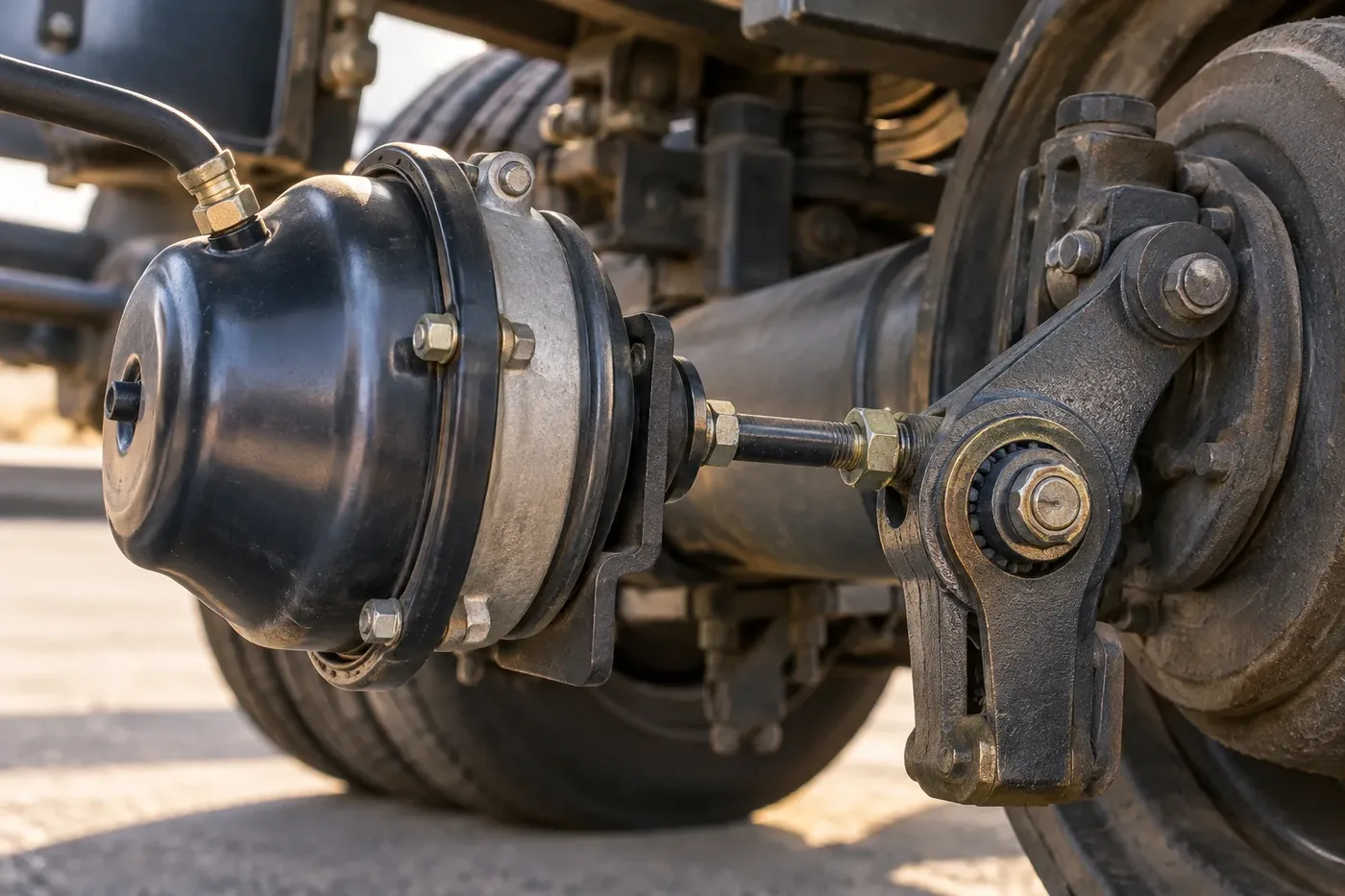
Correct. Pushrod travel beyond about 1 inch (varies by chamber size) indicates an adjustment issue. Use a marked stroke check or have a mechanic verify.
Question 14 of 20
Slack adjusters need to be checked because:
Correct. Slack adjusters control how far the pushrod must travel to apply the brake. Out-of-adjustment slack adjusters are the leading mechanical cause of out-of-service violations.
Question 15 of 20
The application pressure gauge shows:
Correct. The application gauge (when present) shows brake-application pressure — useful for spotting brake-system problems on long downgrades.
Question 16 of 20
In a dual air-brake system, the time required for air pressure to build from 85 to 100 psi should be no more than:
Correct. In dual air-brake systems, air should build from 85 to 100 psi within 45 seconds at engine governed RPM.
Question 17 of 20
When should you use the trailer hand valve to slow the rig?
Correct. Using the trailer hand valve alone applies brakes only at the trailer wheels and can cause the trailer to lock up and skid. Always use the foot valve to brake.
Question 18 of 20
Stopping distance for a vehicle with air brakes is the sum of:
Correct. Air-brake stopping distance is perception + reaction + brake lag + braking — the brake lag is the unique addition.
Question 19 of 20
When brake drums or shoes get very hot, you should:
Correct. Park where you can let the brakes cool. Do not apply the parking (spring) brake on overheated brakes — it can damage them or cause warpage.
Question 20 of 20
A yellow ABS malfunction lamp on the trailer (typically left side) means:
Correct. A trailer-mounted yellow ABS lamp indicates the trailer's ABS is malfunctioning. Service brakes still work; have the system repaired.
About the Maryland Air Brakes exam
States typically administer 25 Air Brakes questions and require 80% to pass. Questions cover air-brake system parts, dual systems, supply pressure, brake-system warning, slack adjusters, the parking brake, the spring brake, the pre-trip air-system check, and the proper way to perform a leakage-rate test.
The Maryland Motor Vehicle Administration follows the federal CDL standards established by FMCSA. To earn the Air Brakes credential, you must answer at least 80% of the questions correctly. Many candidates score lower the first time because the test pulls from a large pool — refreshing this page will give you a different mix of questions, drawn from the same authoritative source.
Want more practice? Try the full Air Brakes question bank or browse all Maryland CDL practice tests.