Kansas Air Brakes CDL Practice Test
This is a free 20-question practice test for the Air Brakes portion of the Kansas Commercial Driver's License knowledge exam. Questions are pulled from a pool of 71 drawn from the AAMVA CDL Manual, which is the source document the Kansas Division of Vehicles uses to write its actual exam.
How it works: Click an answer. The correct choice highlights in green, and you'll see a short explanation. Aim for 85% or better before you sit for the real test in Kansas.
Question 1 of 20
Pre-trip air-brake check (Step 1) is to:
Correct. In the seven-step air-brake check the first step is testing the parking brake — release service brakes, set parking brake, gently try to move the vehicle in low gear.
Question 2 of 20
Brake fade is the result of:
Correct. Brake fade comes from heat. Manage downgrade speed by gear selection plus intermittent firm brake use, not continuous light pressure.
Question 3 of 20
You hear a steady "ssss" sound while parked with the engine off. This is most likely:
Correct. A steady hiss with the engine off indicates an air leak — find and repair before driving.
Question 4 of 20
You should never leave the vehicle unattended without:
Correct. Set the parking brake. On grades or where unintended movement could occur, chock the wheels in addition.
Question 5 of 20
Which of these is the safest speed for descending a long, steep grade?
Correct. Choose a speed and gear that lets the brakes work intermittently without continuous pressure. Posted truck-grade signs help.
Question 6 of 20
Air brakes are actually three brake systems combined:
Correct. A complete air-brake system has the service brake (foot valve), parking brake (spring/yellow knob), and emergency brake (which is the parking brake working off the spring brake when air drops).
Question 7 of 20
You should drain the air tanks:
Correct. Drain all air tanks at the end of each working day to remove water and compressor oil that has condensed in the tanks.
Question 8 of 20
Manual slack adjusters must be adjusted:
Correct. Drivers may adjust manual slack adjusters in compliance with manufacturer specifications. Automatic slack adjusters are now standard but still require periodic checking.
Question 9 of 20
Pushing the brake pedal harder makes:
Correct. The foot valve modulates air pressure to the brake chambers in proportion to how hard you press the pedal.
Question 10 of 20
The supply pressure gauges show:
Correct. The supply (primary and secondary) pressure gauges show air pressure available for braking — a critical reading before driving and during operation.
Question 11 of 20
The application pressure gauge shows:
Correct. The application gauge (when present) shows brake-application pressure — useful for spotting brake-system problems on long downgrades.
Question 12 of 20
In a dual air-brake system, you should let the air pressure build to at least what level before driving?
Correct. Wait until the system pressure is at least 100 psi before driving in a dual air-brake system.
Question 13 of 20
A yellow ABS malfunction lamp on the cab dash means:
Correct. A yellow ABS lamp on the dash indicates a tractor-ABS malfunction. The base brakes still work normally, but ABS is unavailable until repaired.
Question 14 of 20
Stopping distance for a vehicle with air brakes is the sum of:
Correct. Air-brake stopping distance is perception + reaction + brake lag + braking — the brake lag is the unique addition.
Question 15 of 20
When checking the brakes on a downgrade, you should:
Correct. Watch the air-pressure gauge. If pressure drops faster than the compressor can recover, brakes are being used too aggressively for the gear selection.
Question 16 of 20
For a single vehicle (not a combination) with engine off and brakes released, the maximum allowable air-loss rate is:
Correct. A single vehicle is allowed no more than 2 psi/min of air loss with engine off and brakes released.
Question 17 of 20
The service brakes are operated by:
Correct. Service brakes are applied by the foot valve / brake pedal. The yellow and red knobs control parking and trailer-supply functions.
Question 18 of 20
The trailer air-supply control:
Correct. The trailer air-supply (tractor protection) is a red eight-sided knob. Push in to supply air to the trailer; pull out to shut off air.
Question 19 of 20
Modern trucks have ABS that is required on:
Correct. Federal rule: tractors built after March 1, 1997, and trailers and single-unit air-braked vehicles after March 1, 1998, must have ABS.
Question 20 of 20
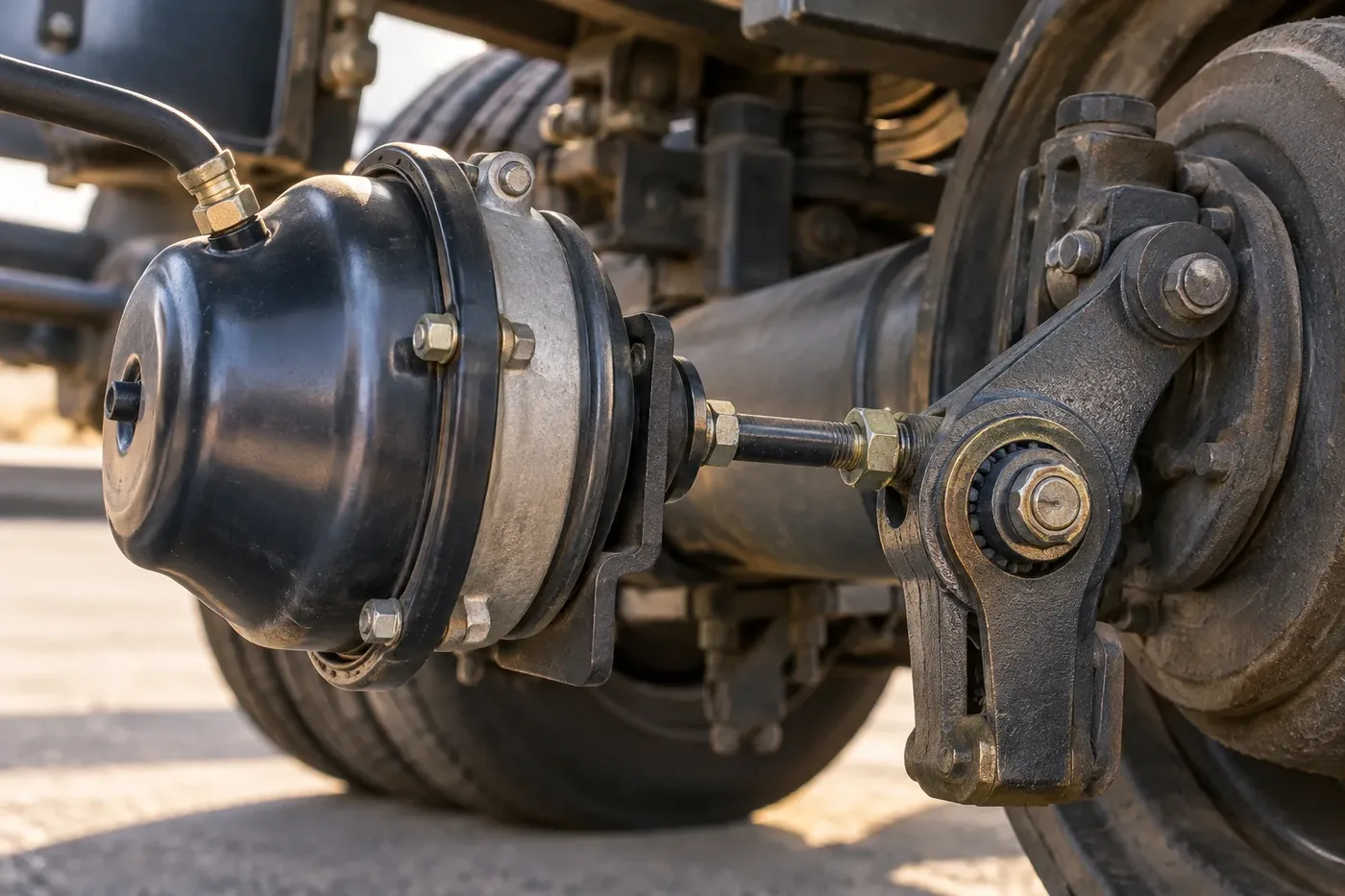
Slack adjusters need to be checked because:
Correct. Slack adjusters control how far the pushrod must travel to apply the brake. Out-of-adjustment slack adjusters are the leading mechanical cause of out-of-service violations.
About the Kansas Air Brakes exam
States typically administer 25 Air Brakes questions and require 80% to pass. Questions cover air-brake system parts, dual systems, supply pressure, brake-system warning, slack adjusters, the parking brake, the spring brake, the pre-trip air-system check, and the proper way to perform a leakage-rate test.
The Kansas Division of Vehicles follows the federal CDL standards established by FMCSA. To earn the Air Brakes credential, you must answer at least 80% of the questions correctly. Many candidates score lower the first time because the test pulls from a large pool — refreshing this page will give you a different mix of questions, drawn from the same authoritative source.
Want more practice? Try the full Air Brakes question bank or browse all Kansas CDL practice tests.