Iowa Air Brakes CDL Practice Test
This is a free 20-question practice test for the Air Brakes portion of the Iowa Commercial Driver's License knowledge exam. Questions are pulled from a pool of 71 drawn from the AAMVA CDL Manual, which is the source document the Iowa Department of Transportation Motor Vehicle Division uses to write its actual exam.
How it works: Click an answer. The correct choice highlights in green, and you'll see a short explanation. Aim for 85% or better before you sit for the real test in Iowa.
Question 1 of 20
The governor controls:
Correct. The governor cycles the compressor: it cuts the compressor in around 100 psi and cuts it out around 125 psi.
Question 2 of 20
If you must drive a vehicle with manual front-wheel-brake limiting valve, you should keep it in the "normal" position:
Correct. Keep the front-wheel limiting valve in the "normal" position. Modern trucks rarely have this valve, but if equipped, leaving it in "slippery" reduces front braking and lengthens stopping distance.
Question 3 of 20
A long downgrade requires:
Correct. Pick a low gear before starting down. Use the brakes in firm, intermittent applications: brake to 5 mph below safe speed, release, repeat.
Question 4 of 20
Modulating valves on the trailer:
Correct. The trailer service brakes are modulated — pressing harder on the foot valve produces more brake-chamber pressure at the trailer.
Question 5 of 20
A low-air-pressure warning device must come on at or before:
Correct. A federal-mandated low-air-pressure warning (light, buzzer, or wig-wag) must activate at or before 60 psi.
Question 6 of 20
The parts of an air-brake system include:
Correct. Air-brake systems use a compressor, governor, storage tanks, foot valve, and brake chambers — distinct from hydraulic systems used in cars.
Question 7 of 20
The supply pressure gauges show:
Correct. The supply (primary and secondary) pressure gauges show air pressure available for braking — a critical reading before driving and during operation.
Question 8 of 20
Air brakes are actually three brake systems combined:
Correct. A complete air-brake system has the service brake (foot valve), parking brake (spring/yellow knob), and emergency brake (which is the parking brake working off the spring brake when air drops).
Question 9 of 20
Antilock braking systems (ABS):
Correct. ABS prevents wheel lockup during hard braking, allowing you to steer to safety. ABS does not necessarily shorten stopping distance.
Question 10 of 20
Continuous use of the brakes on a long downgrade can cause:
Correct. Holding the brakes overheats them and causes brake fade — drums expand and brake compounds lose effectiveness, reducing braking force.
Question 11 of 20
Air storage tanks are used to:
Correct. Air storage (or "supply") tanks hold compressed air ready for brake application. Trucks have multiple tanks for redundancy.
Question 12 of 20
The application pressure gauge shows:
Correct. The application gauge (when present) shows brake-application pressure — useful for spotting brake-system problems on long downgrades.
Question 13 of 20
The S-cam:
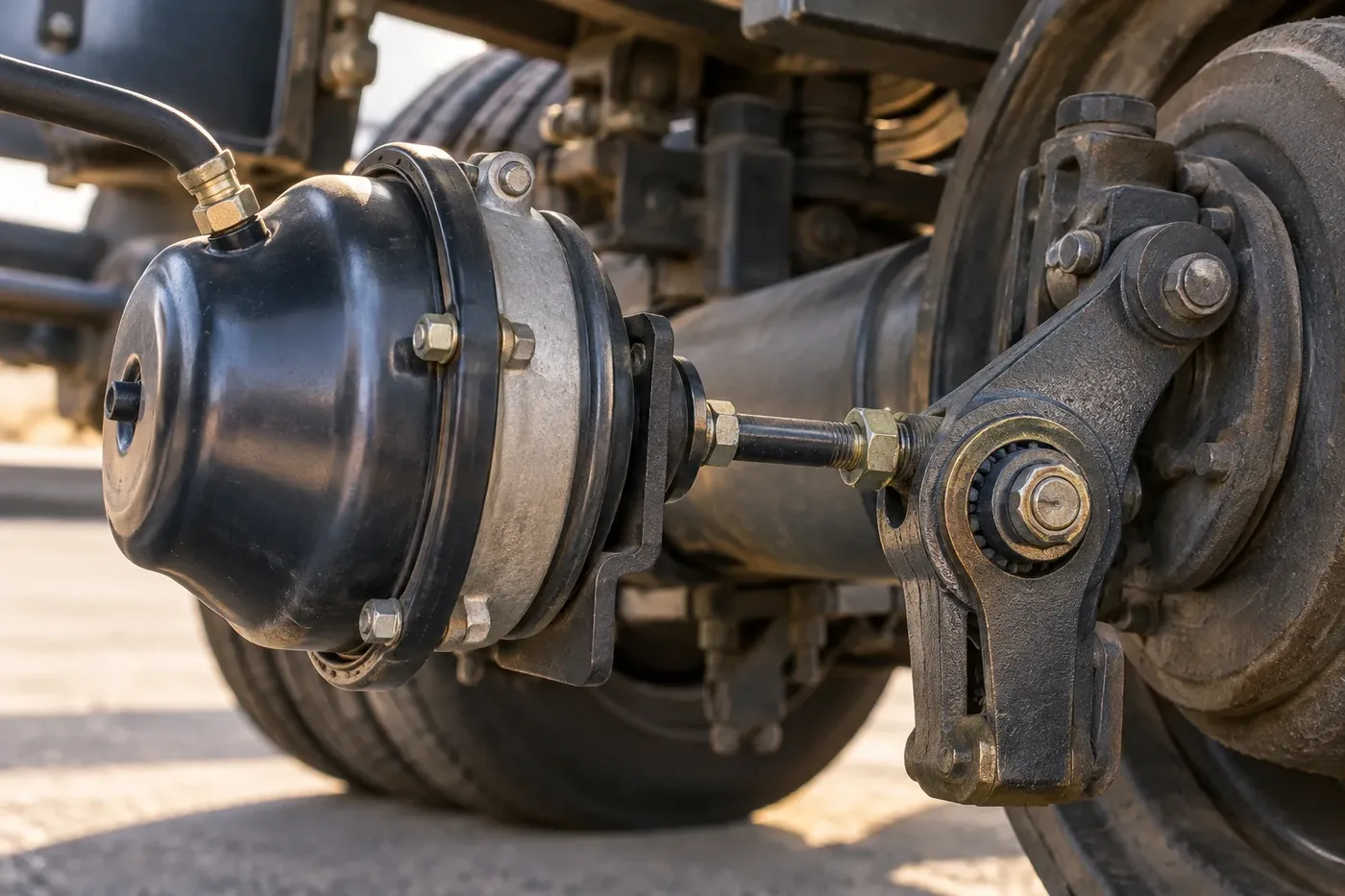
Correct. When the foot valve is pressed, air pushes the brake-chamber pushrod, which moves the slack adjuster, which rotates the S-cam shaft, forcing the shoes against the drum.
Question 14 of 20
For a combination vehicle (tractor and trailer) with engine off and brakes released, the maximum allowable air-loss rate is:
Correct. A combination vehicle is allowed no more than 3 psi/min with brakes released, or 4 psi/min with brakes applied.
Question 15 of 20
In a fully charged dual air-brake system at idle, you should test the low-pressure warning by:
Correct. Engine off, fan the brake pedal to bleed pressure. The low-pressure warning device should activate before pressure drops below 60 psi.
Question 16 of 20
In an emergency stop on a non-ABS vehicle, you should:
Correct. Stab braking applies brakes hard until the wheels lock, then releases when you feel skid — this slows the vehicle while keeping it straight.
Question 17 of 20
The "tractor protection valve" closes (cuts off air to the trailer) automatically when:
Correct. The tractor protection valve protects the tractor from a runaway air loss in case of a trailer break-away or air leak — it closes between 20 and 45 psi.
Question 18 of 20
Pre-trip air-brake check (Step 1) is to:
Correct. In the seven-step air-brake check the first step is testing the parking brake — release service brakes, set parking brake, gently try to move the vehicle in low gear.
Question 19 of 20
When brake drums or shoes get very hot, you should:
Correct. Park where you can let the brakes cool. Do not apply the parking (spring) brake on overheated brakes — it can damage them or cause warpage.
Question 20 of 20
You are driving a fully loaded combination vehicle on a steep downgrade. Your safe speed is 30 mph and you have already shifted to a lower gear. The proper braking technique is to:
Correct. The "snub-and-release" method: brake firmly to drop 5 mph below safe speed, release until safe speed returns, repeat. Holding the brakes overheats them.
About the Iowa Air Brakes exam
States typically administer 25 Air Brakes questions and require 80% to pass. Questions cover air-brake system parts, dual systems, supply pressure, brake-system warning, slack adjusters, the parking brake, the spring brake, the pre-trip air-system check, and the proper way to perform a leakage-rate test.
The Iowa Department of Transportation Motor Vehicle Division follows the federal CDL standards established by FMCSA. To earn the Air Brakes credential, you must answer at least 80% of the questions correctly. Many candidates score lower the first time because the test pulls from a large pool — refreshing this page will give you a different mix of questions, drawn from the same authoritative source.
Want more practice? Try the full Air Brakes question bank or browse all Iowa CDL practice tests.