Georgia Air Brakes CDL Practice Test
This is a free 20-question practice test for the Air Brakes portion of the Georgia Commercial Driver's License knowledge exam. Questions are pulled from a pool of 71 drawn from the AAMVA CDL Manual, which is the source document the Georgia Department of Driver Services uses to write its actual exam.
How it works: Click an answer. The correct choice highlights in green, and you'll see a short explanation. Aim for 85% or better before you sit for the real test in Georgia.
Question 1 of 20
The governor controls:
Correct. The governor cycles the compressor: it cuts the compressor in around 100 psi and cuts it out around 125 psi.
Question 2 of 20
In a dual air-brake system, the time required for air pressure to build from 85 to 100 psi should be no more than:
Correct. In dual air-brake systems, air should build from 85 to 100 psi within 45 seconds at engine governed RPM.
Question 3 of 20
You hear a steady "ssss" sound while parked with the engine off. This is most likely:
Correct. A steady hiss with the engine off indicates an air leak — find and repair before driving.
Question 4 of 20
Continuous use of the brakes on a long downgrade can cause:
Correct. Holding the brakes overheats them and causes brake fade — drums expand and brake compounds lose effectiveness, reducing braking force.
Question 5 of 20
When you make a normal stop with air brakes, you should:
Correct. For normal stops, apply steady firm pressure on the foot valve and adjust to maintain a smooth stop.
Question 6 of 20
On a vehicle with ABS, in an emergency stop you should:
Correct. ABS lets you brake hard and continue steering. Brake firmly and avoid pumping — pumping defeats the system.
Question 7 of 20
During a brake check, the brake pedal should not move more than ___ when you push it down hard with the engine off and air pressure built up:
Correct. After full charge, holding the foot valve down should produce a firm pedal that moves only a few inches. Pedal sinking to the floor indicates a leak.
Question 8 of 20
A condition called "brake fade" is most likely on:
Correct. Brake fade comes from heat from extended use — most commonly on long, steep downgrades where the brakes are working continuously.
Question 9 of 20
Which of these is the safest speed for descending a long, steep grade?
Correct. Choose a speed and gear that lets the brakes work intermittently without continuous pressure. Posted truck-grade signs help.
Question 10 of 20
For a single vehicle with engine off and brakes applied, the maximum allowable air-loss rate is:
Correct. A single vehicle is allowed no more than 3 psi/min with brakes fully applied.
Question 11 of 20
A low-air-pressure warning device must come on at or before:
Correct. A federal-mandated low-air-pressure warning (light, buzzer, or wig-wag) must activate at or before 60 psi.
Question 12 of 20
Slack adjusters need to be checked because:
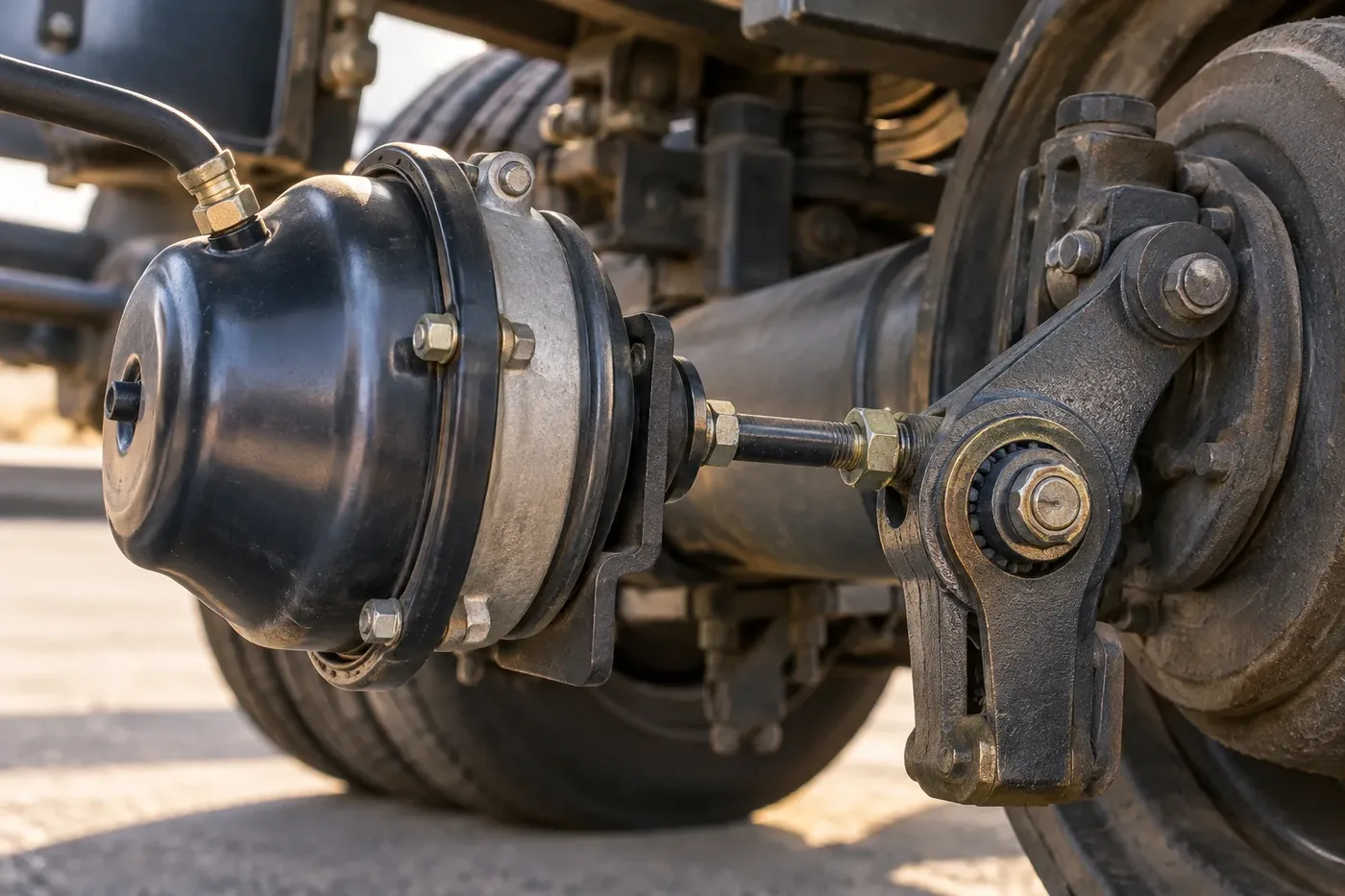
Correct. Slack adjusters control how far the pushrod must travel to apply the brake. Out-of-adjustment slack adjusters are the leading mechanical cause of out-of-service violations.
Question 13 of 20
The application pressure gauge shows:
Correct. The application gauge (when present) shows brake-application pressure — useful for spotting brake-system problems on long downgrades.
Question 14 of 20
In an emergency stop on a non-ABS vehicle, you should:
Correct. Stab braking applies brakes hard until the wheels lock, then releases when you feel skid — this slows the vehicle while keeping it straight.
Question 15 of 20
You should perform a static air-leakage test by:
Correct. Engine off, brakes released, fully charged system: watch for air loss over one minute. Then apply brakes and check again.
Question 16 of 20
Pushing the brake pedal harder makes:
Correct. The foot valve modulates air pressure to the brake chambers in proportion to how hard you press the pedal.
Question 17 of 20
The service brakes are operated by:
Correct. Service brakes are applied by the foot valve / brake pedal. The yellow and red knobs control parking and trailer-supply functions.
Question 18 of 20
In a fully charged dual air-brake system at idle, you should test the low-pressure warning by:
Correct. Engine off, fan the brake pedal to bleed pressure. The low-pressure warning device should activate before pressure drops below 60 psi.
Question 19 of 20
The parts of an air-brake system include:
Correct. Air-brake systems use a compressor, governor, storage tanks, foot valve, and brake chambers — distinct from hydraulic systems used in cars.
Question 20 of 20
Air storage tanks are used to:
Correct. Air storage (or "supply") tanks hold compressed air ready for brake application. Trucks have multiple tanks for redundancy.
About the Georgia Air Brakes exam
States typically administer 25 Air Brakes questions and require 80% to pass. Questions cover air-brake system parts, dual systems, supply pressure, brake-system warning, slack adjusters, the parking brake, the spring brake, the pre-trip air-system check, and the proper way to perform a leakage-rate test.
The Georgia Department of Driver Services follows the federal CDL standards established by FMCSA. To earn the Air Brakes credential, you must answer at least 80% of the questions correctly. Many candidates score lower the first time because the test pulls from a large pool — refreshing this page will give you a different mix of questions, drawn from the same authoritative source.
Want more practice? Try the full Air Brakes question bank or browse all Georgia CDL practice tests.