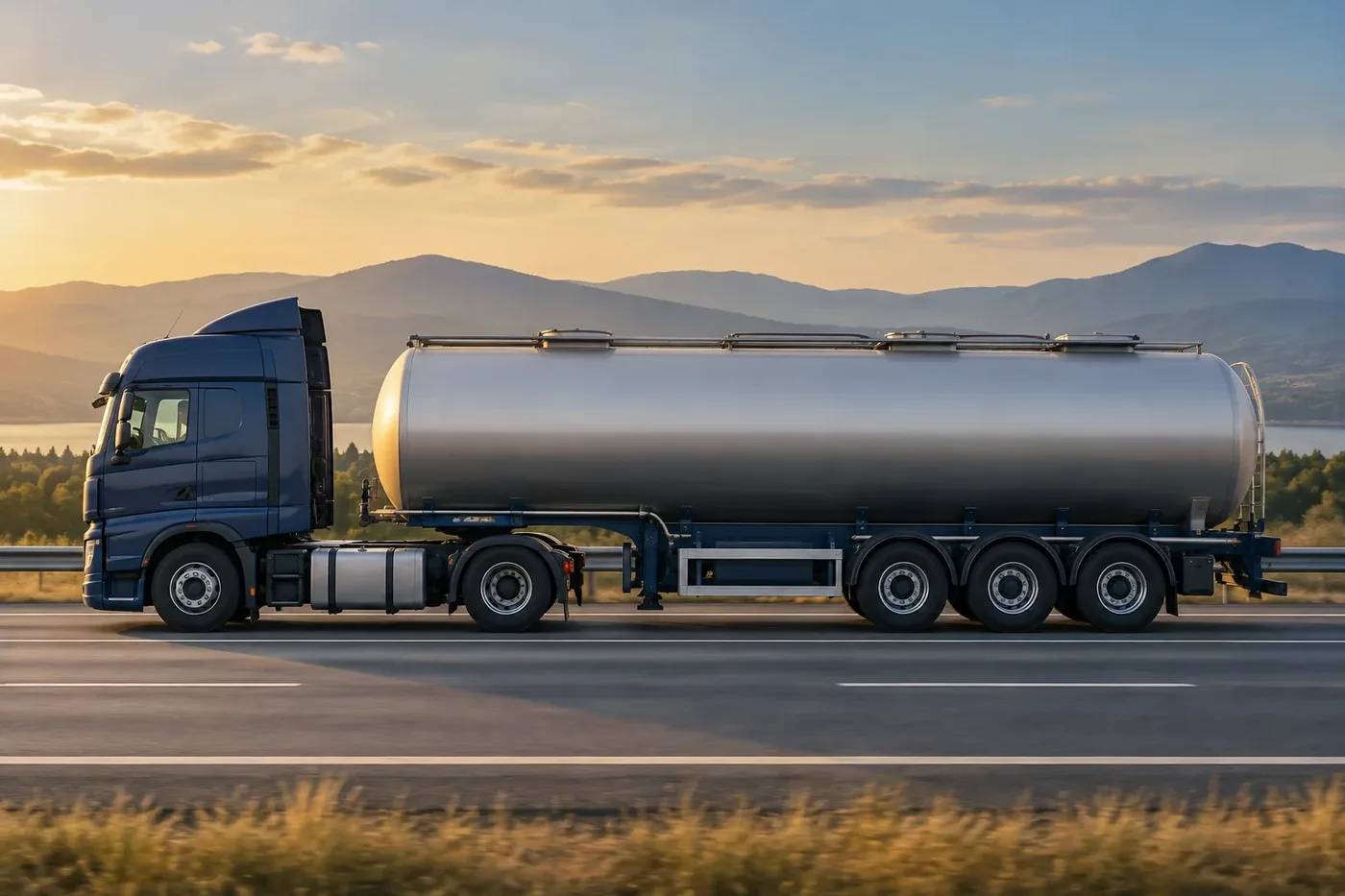
Alaska Tanker CDL Practice Test
This is a free 20-question practice test for the Tanker portion of the Alaska Commercial Driver's License knowledge exam. Questions are pulled from a pool of 50 drawn from the AAMVA CDL Manual, which is the source document the Alaska Division of Motor Vehicles uses to write its actual exam.
How it works: Click an answer. The correct choice highlights in green, and you'll see a short explanation. Aim for 85% or better before you sit for the real test in Alaska.
Question 1 of 20
A "smooth bore" tank has:
Correct. A smooth-bore tank has no internal divisions or baffles. Surge is dramatic; brake gently to avoid being pushed forward by the load.
Question 2 of 20
When backing a tanker, you should:
Correct. Tankers can have unusual mirror angles and rear visibility. Use a helper, move slowly, and watch for tank-mount lights and overhead clearance.
Question 3 of 20
When you drive a tanker on slippery roads, you should:
Correct. Reduce speed by at least one-third on wet roads, by half on snow. Liquid loads make recovery from a skid much harder.
Question 4 of 20
When unloading from a top-mounted hatch, you should:
Correct. Top-mount work involves fall hazard. Use the ladder safely, follow fall-protection procedures, and secure hatches after.
Question 5 of 20
When unloading product from a cargo tank, you should:
Correct. Pre-check receiving container, bond and ground, control flow rate to prevent splash and spill, and remain attentive for flammable liquids.
Question 6 of 20
Cargo tanks must be inspected and tested:
Correct. Cargo tanks have specific inspection and test schedules based on their DOT specification (visual, leakage, internal, pressure, and thickness tests).
Question 7 of 20
The driver should plan extra time for:
Correct. A loaded tanker accelerates slower, brakes longer, and turns wider. Plan your trip and reactions accordingly.
Question 8 of 20
A tanker with an empty compartment between two full compartments may:
Correct. Mixed full and empty compartments produce complex surge patterns. Plan acceleration and braking conservatively.
Question 9 of 20
Tankers should be driven with:
Correct. Tankers stop slower and roll easier. Increase following distance and use gentler steering and braking inputs.
Question 10 of 20
You should never load a tank completely full because:
Correct. Liquids expand with temperature. Without outage, a warming load can over-pressurize and rupture the tank.
Question 11 of 20
A loaded tanker on a curve is most likely to:
Correct. Side surge plus high CG creates a tipping moment well above what a flat-bed of equal weight produces. Speed reduction in advance is the only safe answer.
Question 12 of 20
A pressure-relief device that vents during transit:
Correct. Continuous venting indicates over-pressure (often from over-fill or sun heating an over-filled tank). Stop and investigate; do not continue with a venting tank.
Question 13 of 20
When the surge in a tanker pushes the rig forward at a stop, you may:
Correct. Forward surge can push the entire rig forward — past stop lines, into intersections, into the vehicle ahead. Plan your stops with extra distance.
Question 14 of 20
A loaded tanker traveling 10 mph above the safe curve speed has a:
Correct. Centripetal force scales with speed squared. Just 10 mph over safe speed can take you past the rollover threshold of a loaded tanker.
Question 15 of 20
Tank specification "MC-306" or "DOT-406" generally refers to:
Correct. MC-306 (older) and DOT-406 (current) are non-pressure cargo tanks for flammable and combustible liquids — typical fuel tankers.
Question 16 of 20
A heavy liquid load with a baffled tank may still surge:
Correct. Baffles reduce front-to-back surge but do not affect side-to-side surge — bulkheads are typically transverse, not longitudinal.
Question 17 of 20
When you stop a placarded tanker carrying flammable liquid at a railroad crossing, you must stop:
Correct. Placarded hazmat (which most fuel tankers are) must stop 15 to 50 feet from the nearest rail. Look, listen, and cross only when clear.
Question 18 of 20
Carrying a smooth-bore tank up a ramp or off a curb:
Correct. Climbing causes the load to surge backward and then forward as you level off — affecting throttle response, traction, and braking.
Question 19 of 20
Tank vehicles should not be driven:
Correct. On long downgrades, select a low gear before starting down and use firm intermittent brake applications to prevent fade.
Question 20 of 20
A "baffled" tank has:
Correct. Baffled tanks have internal bulkheads with holes — they slow surge but still allow product to flow through during loading and unloading.
About the Alaska Tanker exam
Most states administer 20 Tanker questions and require 80% to pass. Topics include the unique handling of liquid loads, surge effects, baffles vs. smooth-bore, outage and expansion, inspection of the cargo tank, and emergency procedures.
The Alaska Division of Motor Vehicles follows the federal CDL standards established by FMCSA. To earn the Tanker credential, you must answer at least 80% of the questions correctly. Many candidates score lower the first time because the test pulls from a large pool — refreshing this page will give you a different mix of questions, drawn from the same authoritative source.
Want more practice? Try the full Tanker question bank or browse all Alaska CDL practice tests.